The world that is grappling under the energy shock engendered by the U.S.-Iran war now faces an additional geopolitical threat as a crisis in Cuba has the potential to layer in additional chokepoint risk on top of the one faced in the Persian Gulf region.
The nation’s aging electricity grid on Monday collapsed under strain, with the impact compounded by the U.S. embargo on oil imports to the communist nation. Cuba’s Ministry of Energy and Mines confirmed via a X post late Monday that a “total disconnection” of the National Power System (SEN) had occurred.
Trump Lock Horns: U.S. President Donald Trump used the domestic crisis in Cuba to renew calls for a regime change in the country. While speaking to reporters at his Oval Office on Monday, the president called a potential takeover of Cuba in some form as a "big honor."
"Whether I free it, take it, I think I could do anything I want with it, if you want to know the truth. They are a very weakened nation right now," he said.
The Trump administration is seeking to overthrow Cuban President Miguel Díaz-Canel, a New York Times report stated, citing people familiar with the matter.
Díaz-Canel has responded by communicating his resolve to take on any external aggression. "In the face of the worst scenario, #Cuba is accompanied by a certainty: any external aggressor will clash with an impregnable resistance," translated statement from his X post on Tuesday read.
So, how does this newest geopolitical tension aggravate the global energy crisis?
The island-wide blackout in Cuba has plunged the nation into darkness, cutting off power supplies to about 11 million people and disrupting essential services such as hospitals. Cuban President Miguel Diaz-Canel reportedly said on Friday that the country hasn’t received any oil shipments for more than three months, blaming the U.S. blockade for the predicament.
If the crisis forces Cuba to take a hard stance against the U.S., its longstanding nemesis, it could have spillover effects and disruptions in regional energy flows.
Potential Caribbean maritime risk could stem from:
- Governments restricting access to certain waters, inspecting ships more frequently or requiring naval escorts, all of which will likely reduce shipment speed and raising freight rates
- Higher war risk premium
- Additional sanctions
According to a December 2024 Observer Research Foundation report, between 2022 and 2024:
- Political and geopolitical risk premiums rose by 13%.
- Insurance premiums for the shipping industry spiked by 20%. Nearly 90% of the global trade is seaborne.
- War risk insurance premiums climbed to 0.75%-1% from merely 0.05%.
Diving Deep into Looming Threat: Unlike the Persian Gulf-Red Sea route, the Caribbean-Panana system disruption may not pose a significant threat to global production volumes. According to the Energy Information Administration (EIA) data, Panama Canal, the chokepoint which connects the Atlantic and Pacific oceans, accounts for only roughly 2.3% of the world maritime oil trade.
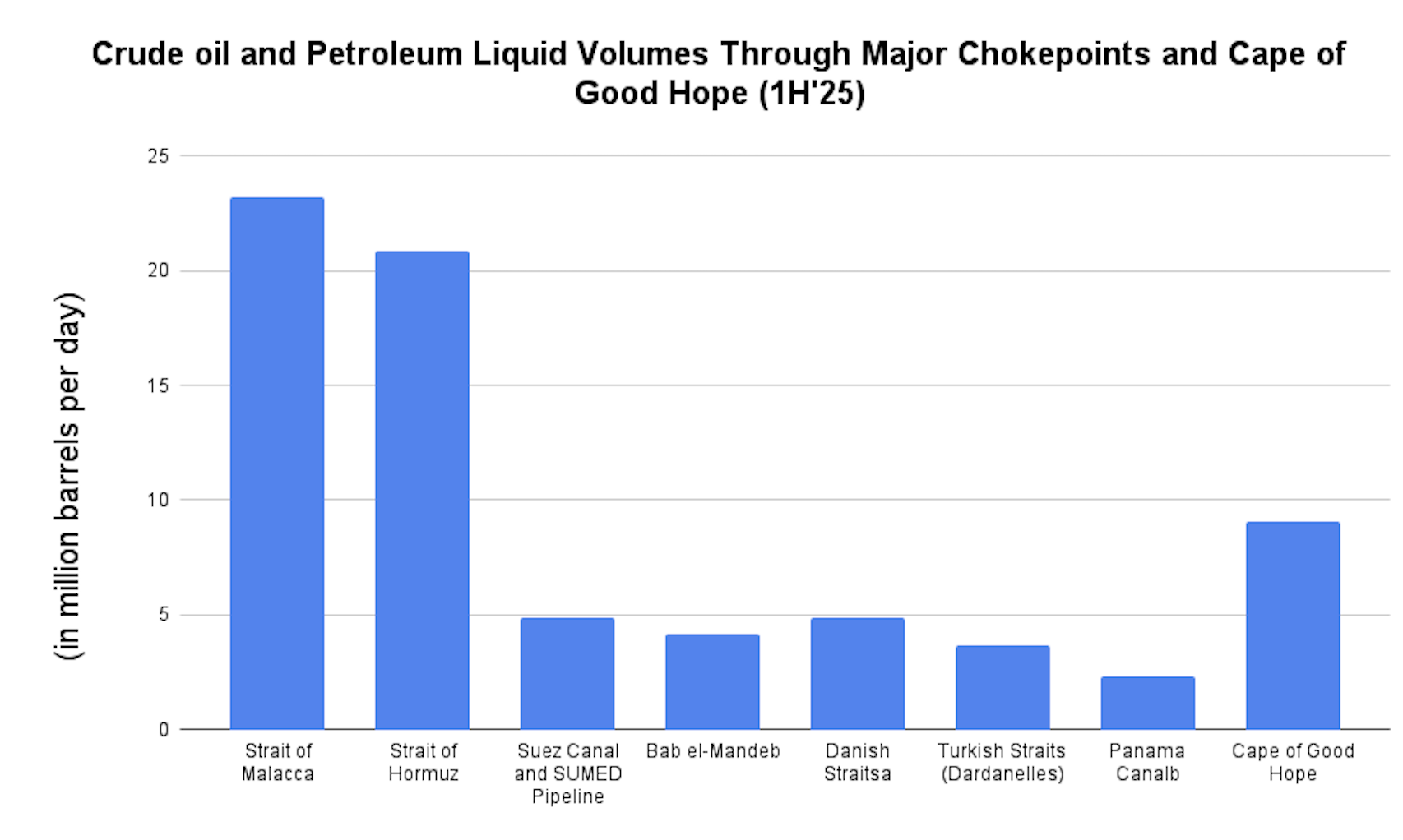
Data Source: EIA
But it could impact U.S. Gulf Coast logistics of energy products by raising war risk premiums and causing operational constraints in the approaches that connect the Gulf of Mexico to the Atlantic and the Panama Canal System.
The U.S. Gulf Coast energy ecosystem includes the Gulf of Mexico oil hub, refining and export infrastructure along the Texas and Louisiana coasts and the key shipping routes that transport crude oil and refined products to the global markets.
The Panama Canal is key for the trade between the U.S. and East Asia as well as the western coast of South America. A disruption in the system may force scouting of circuitous alternate routes, driving up shipping costs.
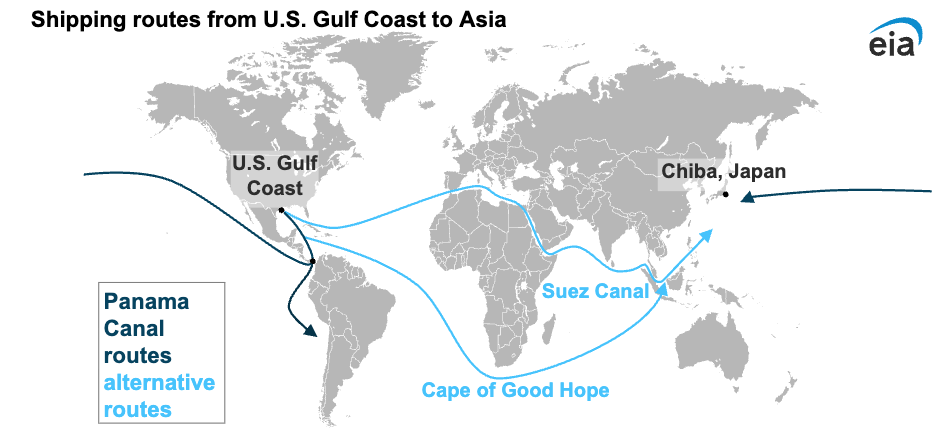
Source: EIA
Which commodities could face the brunt of a potential Caribbean maritime risk?
- Crude oil flows, particularly exports from the U.S. Gulf Coast, could face logistical constraints.
- Add to that the pressure on other refined petroleum products such as diesel, jet fuel, fertilizers; (It is believed that these products flash shortage signals much earlier than crude).
- Natural gas by-products such as natural gas liquids (NGLs): EIA estimates show that the U.S. is now the world’s largest liquified natural gas (LNG) exporter, having transported out 15 billion cubic feet per day (Bcf/d) in 2025. The major U.S. LNG terminals are located along the U.S. Gulf Coast, with the Sabine Pass in Louisiana being the biggest terminal in the U.S.
- Metals and non-metals such as:
- sulfur, an input used for manufacturing fertilizers and other chemicals
- Cobalt
- Lead
- Nickel
- Zinc
- Agricultural commodities (both due to supply hit from Cuba and also higher fertilizer and diesel costs as well as higher freight and insurance costs); According to Observatory of Economic Complexity (OEC), top exports from the country in 2024 included:
- Rolled tobacco ($418 million)
- Zinc Ore ($107 million)
- Nickel Mattes ($89 million)
- Hard liquor ($75 million)
Some energy commodity prices are already hitting through the roof. Diesel prices have surged recently, topping $5 a gallon and approaching the Russia-Ukraine war highs of $5.816, according to AAA data. The Brent oil futures trade above the $100-a-barrel.
Given the U.S. is a net oil exporter, any aggravation in the Cuban crisis that could impede the Caribbean maritime system could come back to bite the country.
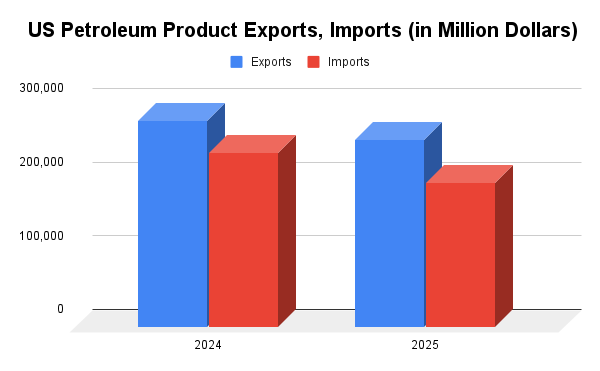
Data Source: Bureau of Economic Analysis
The current LNG deficit may have been driven by the Persian Gulf disruptions but Cuba-front disruption could also stoke further the European gas price pressure, primarily due to elevated war-risk premium and delay costs.
Cuba also boasts of some key mineral reserves, including cobalt and nickel which are used in electric vehicle (EV) battery manufacturing. US Geological Survey data shows that in 2023, the country produced 3,100 metric tons of cobalt, 175,000 metric tons of iron and steel, 35,000 metric tons of lead, 73,000 metric tons of nickel mine and intermediate products, and 50,000 metric tons of Zinc and Zinc content.
Cuba was the sixth largest producer of cobalt in 2024, but accounted for merely 1.3% of the global supply, according to data provided by the Canadian government.

Source: Government of Canada
Where does it start to pinch? The first sign of strain would emerge in market pricing of futures tied to energy and other commodities, refined product cracks and war risk quotes etc.
After weeks or even months, the effect will gradually show up as inventory drawdown, refinery reoptimization, policy responses such as emergency reserve releases like the one we saw last week and spike in inflation etc. In the medium to long-term, other negative effects such as demand destruction, capital expenditure deferrals, credit stress and second-round inflation effects show up.
Latest updates from Cuba, however, offer a glimmer of hope. Posting on X, Cuba’s Prime Minister Manuel Marrero Cruz said the SEN has been interconnected from Pinar del Río to Holguín provinces, and that work has been underway to restore power in the remaining provinces in the eastern part of the country, where currently microsystems keep vital services operational.
A positive offshoot of the whole blackout saga is the new messaging emerging from Havana. Key government officials have signaled willingness to open the country’s flailing economy to American Cubans, allowing them to set up businesses in the country and own property.
However, Donald Trump’s belligerence and Cuba’s intransigence could rapidly escalate tensions, unsettling the already fragile market sentiment.
Read Next: First G10 Hike Is In: Iran War Pushes RBA Into Back-to-Back Rate Hikes, AUD/USD Subdued Ahead of Fed