U.S. consumer prices for February aligned with expectations but a rate cut may not be on the Federal Reserve’s agenda, when its rate-setting committee meets next week. Nevertheless, the consumer price inflation (CPI) report released by the Bureau of Labor Statistics (BLS) on Wednesday triggered a reaction in the market, with the S&P 500 E-mini (ES) futures moving higher and Treasury prices clawing back some of the early New York session’s losses.
Crunching Headline Inflation Numbers:
- Consumer prices rose 0.3% month-over-month (MoM) in February, slightly faster than the 0.2% increase in the previous month. The accelerated growth, however, aligned with the consensus estimates.
- The annual CPI rate was 2.4%, flat with the month-ago level and in line with the average analysts’ estimate.
- Core consumer prices, which excludes food and energy, rose 0.2% MoM, with the rate of increase flat with January and meeting economists’ average estimate.
- The annual core CPI was at 2.5%, the same pace as in the previous month, and meeting expectations. This marks a five-year low.
The annual rates of both the CPI and core CPI continued to remain above the Fed’s 2% target, although some have come to consider it as a new normal. St. Louis Fed Economist Fernando Martin said in a blog post in October last that “the U.S. economy is in a new above-target inflation regime, which mirrors the below-target inflation regime of the pre-pandemic era.”
That said, the economist stated that longer-run inflation expectations, though reacting to the new reality, have increased by less than actual inflation. This shows the markets still believe the Fed will deliver on its 2% inflation goal.
What Underlying Details Reveal:
- The monthly rate of increase in food prices accelerated to 0.4% from 0.2%
- Energy prices, especially energy commodity prices grew at a faster rate (0.6% Vs -1.5%)
- New vehicle prices unchanged Vs 0.1% rise in January
- Used-car prices fell at a slower rate. (-0.4% Vs -1.8%)
- Apparel prices rose at a faster rate. (1.3% Vs. 0.3%)
- Shelter prices rose at a flat pace. (0.2%); Nevertheless, this component was the largest factor contributing to the increase in the headline number, given shelter accounts for roughly 35%. Owners-equivalent rent also rose by 0.2%.
- Transportation prices rose at a markedly slower pace. (0.2% Vs 1.4%)
LPL Financial Chief Economist Jeffrey Roach flagged a few “problem areas” with the annual inflation rate. The economist noted that electricity prices along with other home utilities rose 0.5% MoM in February, pushing up the annual pace to 5.6%. This is clearly a pressure point for households, he added.
He also sees food prices a concern as the component remains a bone of contention among policymakers. Food prices rose 3.1% from a year ago.
Will Tame Print Matter for Fed? The Federal Open Market Committee is set to meet for a two-day meeting that kicks off on Tuesday. The CME FedWatch Tool, constructed based on futures traders’ expectations, currently puts the odds of a rate pause at 99.3%, up from 98.4% on Tuesday.
CME FedWatch Tool
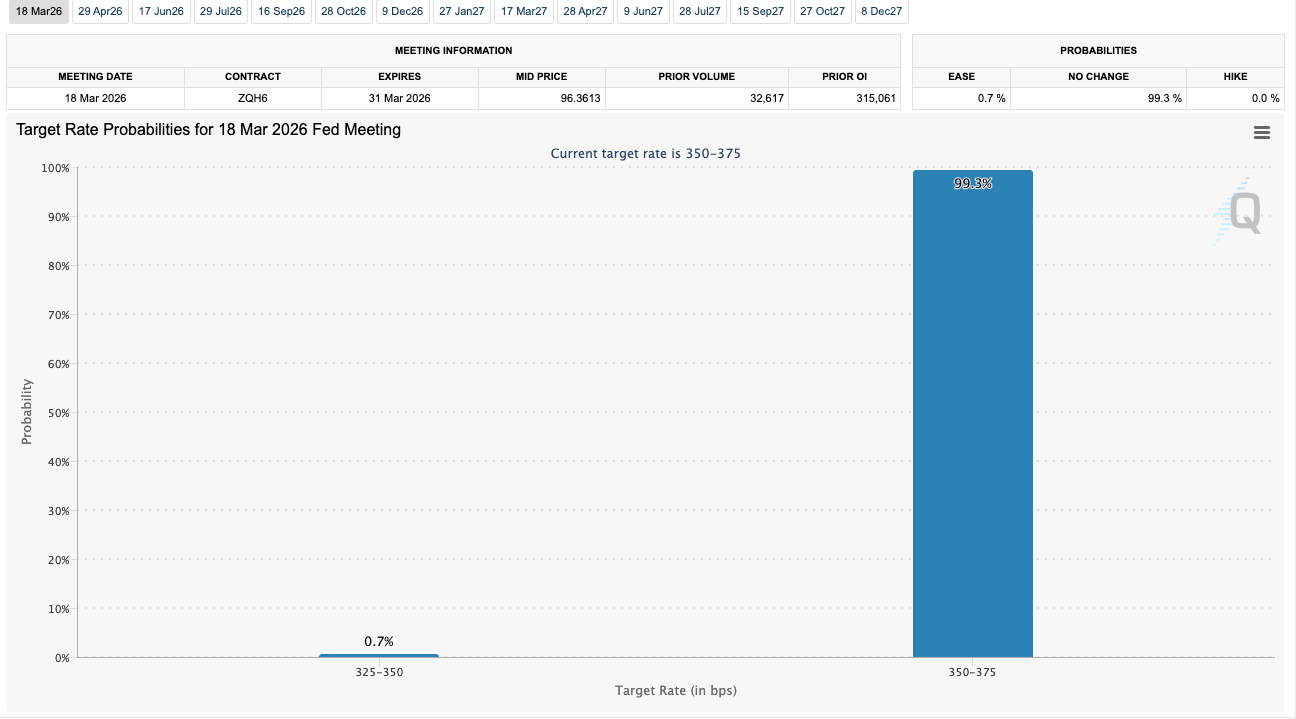
Source: CME
Ahead of the print, economist Mohamed El-Erian said, “The forward-looking information content of this February data release may be unusually limited, given the current shock to energy prices.”
Since late February, crude oil and natural gas prices have surged following the U.S.-Iran war, which has disrupted traffic through the Strait of Hormuz, a key chokepoint through which roughly 20% of global oil supplies normally flow.
Crude Vs Natural Gas Futures (Since Feb. 28)
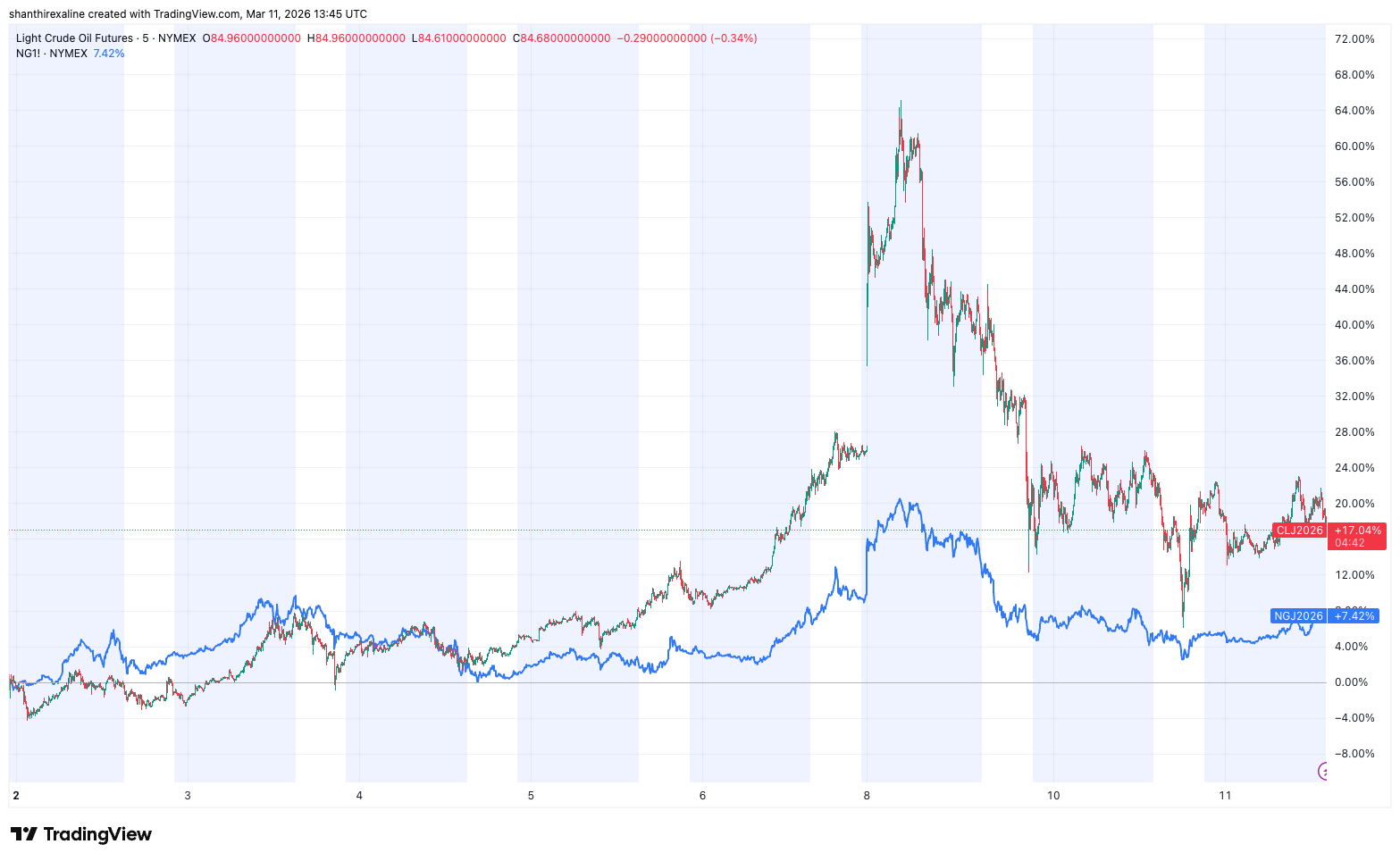
Source: TradingView
Reviewing the data EY Pantheon stated that in normal times, the print would have been benign. “But these are far from normal times, and the data must be interpreted through the lens of distortions from the government shutdown, unprecedented trade policy volatility and record swings in energy prices tied to the conflict in the Middle East.”
The firm believes the government shutdown understated CPI by 0.3 points to 0.4 points, the trade policy was producing a gradual and uneven passthrough of tariffs to consumers and the Middle East tensions will trigger more inflationary pressure in the near term.