The let-up in crude oil futures (CL) proved short-lived, with prices resuming their upward trajectory on Wednesday after a nearly 12% pullback in the previous session. The renewed rally came despite Group of Seven (G-7) leaders’ efforts to calm the market.
Futures tied to the West Texas Intermediate (WTI) benchmark traded at nearly $87 a barrel in the early New York session, up over 3% from Tuesday’s close.
Extraordinary Measures Coming? Paris-based International Energy Agency (IEA) could be on the cusp of doing something it has never done before, going by the rumors swirling around the Street. A Wall Street Journal report, citing officials familiar with the matter, stated that the IEA has proposed releasing a massive 400 million barrels of oil from its strategic reserves, more than double the record quantity (182 million barrels) it released during the 2022 oil shock set in motion by the Ukraine-Russia war.
IEA is an autonomous, intergovernmental organization established in 1974 to ensure reliable, affordable and clean energy.
Commenting on IEA’s rumored move, ING strategists said the agency’s members may be looking to make up for at least 10 days of the 20 million barrels per day (mb/d) lost due to the Strait of Hormuz blockade.
Transient Impact? ING sees some capping in oil prices in the coming days, depending on the actual size of the reserve release. The firm, however, believes only a military deescalation can drive crude oil prices sustainably lower. That said, with the proposed release, the IEA could be sending a signal that policymakers are bracing for prolonged supply disruption, it added.
Saudi oil giant Aramco’s CEO Amin Naseer also emphasized how crucial it is to resume oil traffic through the strait. He warned that if the closure of the Strait of Hormuz continues, the disruption would result in “castostrophic” consequences for the world oil market, Al Jazeera reported.
However, Goldman Sachs is relatively hopeful. Close on the heels of raising its oil and TTF natural gas prices forecast in the aftermath of the escalation in the Middle East tensions, the firm stated late Tuesday that strategic reserve release could bring down crude oil prices by $7, depending on how much oil is absorbed into storage.
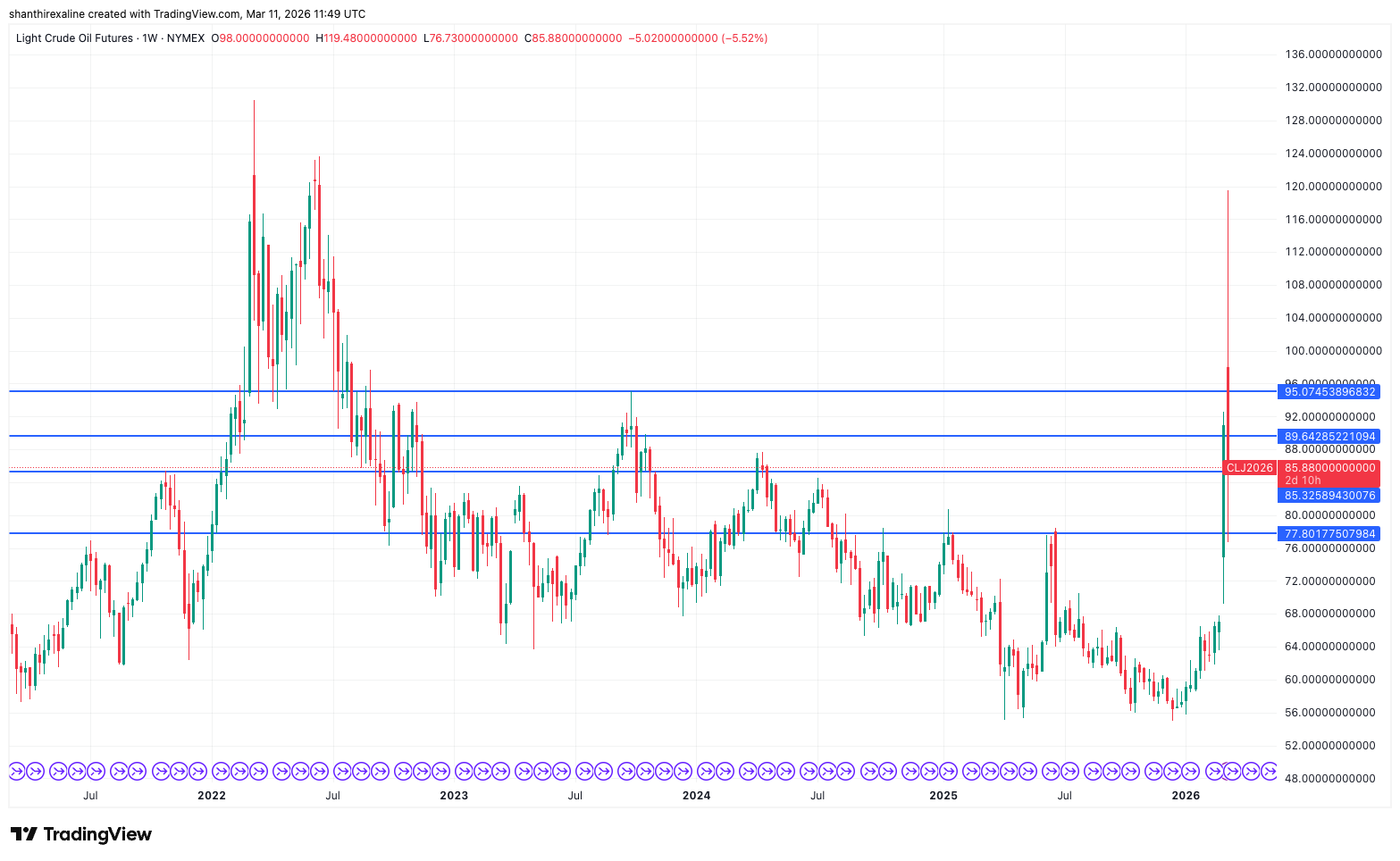
Chart Signals for Crude Futures: The recent spike has pushed crude oil futures well above their 50-day and 200-day simple moving averages (SMAs), which stand at $65.21 and $63.35, respectively, on the one-year chart, underscoring the strength of the current uptrend.
If bullish momentum persists, immediate resistance is seen in the $89–$90 zone, a level that could act as the first hurdle for further gains. A decisive break above this band could open the door for a test of the $95 area, where traders may look to take profits or reassess positions.
On the downside, initial support is located near $85, which may serve as a near-term cushion in case of a pullback. A sustained move below this level could trigger deeper consolidation toward the $78 region, where stronger buying interest may emerge.
Crude Oil Futures (5-Year Chart)
Source: TradingView
The moving average convergence-divergence (MACD) indicator on a one-year chart, points to strengthening upward momentum.
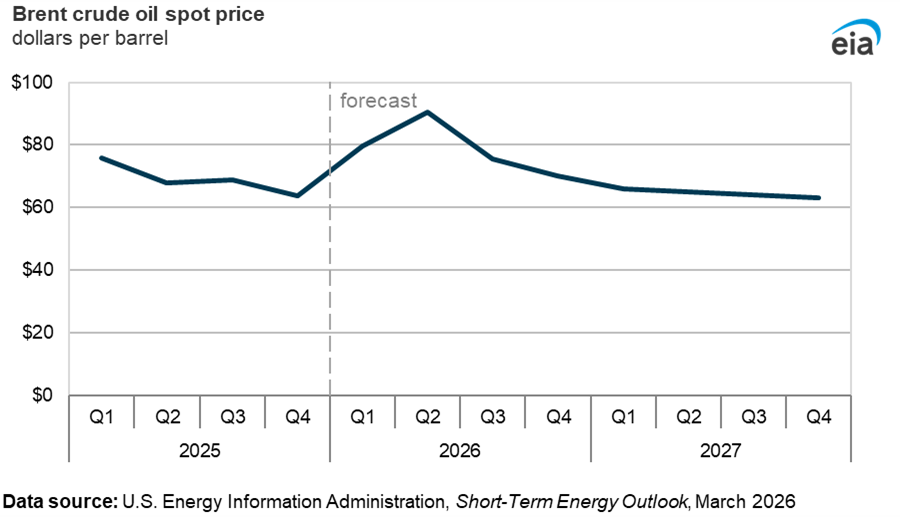
The Outlook: The U.S. Energy Information Administration (EIA) expects Brent crude oil spot price to average $91 a barrel in the second quarter due to some near-term disruptions of oil flows and related production shut-ins, along with a persistent risk premium.
Brent Crude Oil Spot Price
Source: EIA
In its March short-term energy outlook report released Tuesday, EIA stated that once oil flows are reestablished through the Strait of Hormuz, global oil production will continue to outpace consumption over, resulting in global oil inventories increasing by an average of 1.9 mb/d in 2026 and by 3.0 mb/d in 2027.
“Growing oil inventories will again begin to weigh on oil prices, and we expect the Brent price will fall to an average of $70/b in 4Q26 and $64/b in 2027,” it said.
Read Next: February Inflation Print Drops Wednesday: Trading ES, NQ Futures Amid US-Iran Volatility