Shortly after threatening to “obliterate” Iran’s energy and desalination infrastructure, reports emerged that U.S. President Donald Trump is considering an exit from the conflict without fully reopening the Strait of Hormuz.
While the rumor has given rise to a faint hope that the 32-day old could soon come to an end, reports on renewed attacks and counterattacks in the Gulf have emerged, keeping the upside pressure on crude futures intact.
Widespread Strikes: According to media reports huge explosions rocked the Iranian city of Isfahan, which houses a massive underground ammunition depot, with a coordinated U.S.-Israel action blamed for the predicament.
The UAE said it had intercepted eight ballistic missiles, four cruise missiles and 36 drones launched from Iran on Tuesday. Separately, a Kuwaiti oil tanker carrying two million barrels of oil to Qingdao, China, erupted in flames at the Dubai port following drone attacks by Iran. Dubai’s competent authorities have since then confirmed that they have successfully handled the incident, without any oil spill or injuries, Dubai Media Office said in a post on X.
Earlier late Monday, Iran rained missiles on Israel’s Bazan oil refinery in the northern Israeli port city of Haifa, causing an outbreak of massive fire, sending thick smoke over the city.
After the U.S., along with Israel, and Iran engaged with each other in late February, the latter blocked oil follow through Hormuz, a major oil and natural gas chokepoint, driving up prices of energy and refined products.
U.S. set Hormuz reopening as a precondition for ending the war although Iran defiantly resisted the call.
TACOed Yet Again: Trump has taken a step back and told aides he was willing to end the U.S. military campaign against Iran even if the Strait of Hormuz remains largely closed, a Wall Street Journal report, citing administration officials, stated late Monday. The president reportedly said the main objective of the U.S. is to hobble Iran’s navy and its missile stocks, and then wind down the current hostilities, while preferring to diplomatically pursue efforts to resume free trade flow through the region.
According to the report, the U.S. would then seek allies in Europe and the Persian Gulf to take the lead on Hormuz reopening.
Hegseth’s Updates: Offering an update on Operation Epic Fury, the current U.S. military operation in the Middle East, U.S. Secretary of War Pete Hegseth said in a Pentagon press briefing Tuesday morning that regime change has already occurred in Iran. “This new regime, because regime change has occurred, should be wiser than the last,” he said, adding that “President Trump will make a deal. He is willing, and the terms of the deal are known to them.”
The defense secretary said if Iran does not abide by U.S. terms, the U.S. will “continue with even more intensity.”
The market construed the rumor as a TACO (Trump always chickens out) move, and risk assets have rallied in reaction.
According to ING Commodity Strategists Ewa Manthey and Warren Patterson, “a toll or selective access through Hormuz would keep a persistent risk premium in oil, as flows could be curtailed at short notice, while higher insurance and freight costs lift delivery prices even without a full shutdown.”
How Risky Bets have Responded? Crude oil futures, which retreated after the report of Trump TACOing, have resumed their climb amid the renewed strikes.
- The Brent crude futures for May delivery (LCO) climbed nearly 4% to over $117 a barrel.
- The West Texas Intermediate (WTI)-grade crude futures saw volatility as the contract rose to a high of nearly $107-a-barrel. The price has been volatile since.
The average nationwide gas prices in the U.S. rose above $4 a gallon on Tuesday, according to the American Automobile Association. This is the first time gas prices topped $4 since mid-2022 when the world was reeling under supply shock created by the Russia-Ukraine war. The surge in pump prices is critical as it directly feeds through to consumer price inflation.
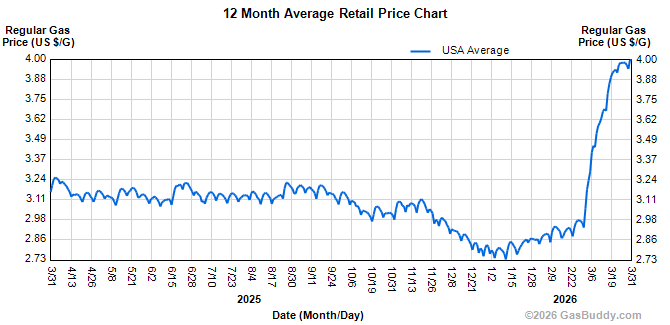
Source: GasBuddy
The ICE-traded Brent crude futures are on track to end March with a gain of over 60%, marking a record monthly performance.
The stock index futures, however, are pointing to a higher open on Wall Street on Tuesday, following three straight sessions of declines. The recent war-induced pullback took the Nasdaq into correction territory. The E-Mini S&P 500, Nasdaq 100 and Dow futures all climbed over 1%.