Gold futures had a stellar year in 2025, rising 65%, thanks to the uncertainty stemming from the U.S. President Donald Trump’s tariff policy, increased central bank buying and the dollar’s weakness. The upward momentum gained steam at the start of this year, sending the yellow metal to an intraday high of $5,586.20 in late January.
Since then, the contract tied to gold prices has moved sideways.
The rangebound move continued in March even as traders hoped for a renewed run after the U.S.-Iran war broke out in late February. The hope rested on gold’s status as a safe haven, which typically boosts its demand amid the war. But it was not to be.
The lackluster phase continues, and in Wednesday’s session, the GC contract trading on CME Group’s New York Mercantile Exchange (NYMEX) fell more than 1% to under $5,200 mark.
What Spoiled Gold’s Party?
- A stronger U.S. dollar has exerted downward pressure on gold futures, which are denominated in the U.S. currency and therefore share an inverse relationship.
- Gold may have been pausing for a breather after its stellar gains.
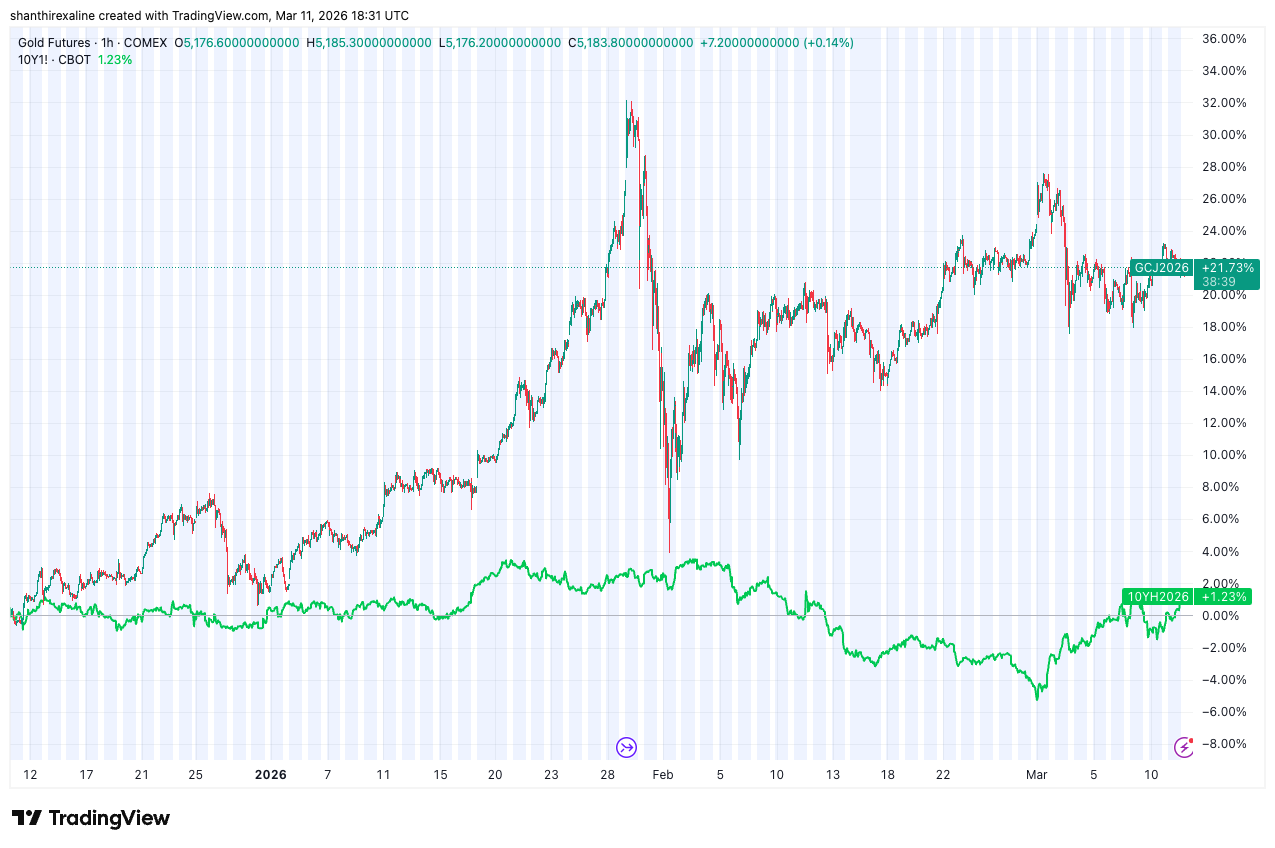
- The yellow metal is also reacting to bond yields, which have come under upward pressure as markets price in rising odds of a near-term rate pause by the Federal Reserve. Higher Treasury yields—particularly real yields, or yields adjusted for inflation expectations—make holding gold less attractive, as the metal does not offer any interest income.
Gold Vs 10-Year T-Note Futures
Source: TradingView
Gold Lags Amid War: Gold futures have trailed the surge in crude oil contracts since the Middle East conflict escalated in late February. The GC contract did rise to a high of $5,405 on March 2 only to pull back.
Gold Vs Crude Vs Dollar Futures (Since Start of War)

Source: TradingView
The yellow metal, however, remains the runaway winner when performance over the past year is considered.
Gold Vs Crude Vs Dollar Futures (1-Year Chart)

Source: TradingView
Will Gold Rally Resume: Gold’s longer-term outlook may still hinge on the direction of interest rates and the dollar. If Treasury yields begin to ease, either due to cooling inflation, weaker economic data or growing expectations of Federal Reserve rate cuts, reviving bullish momentum. Continued geopolitical uncertainty and sustained central bank buying could also underpin demand.
That said, as long as the dollar remains firm and real yields stay elevated, gold may remain range-bound near current levels before attempting another move toward its record highs.
Read Next: US Consumer Prices Stayed Benign in February — Why the Fed Still Won’t Cut Rates Next Week