The U.K. economy continued to grow at an anemic pace in the fourth quarter, according to the first estimate released by the U.K. Office for National Statistics (ONS) on Thursday. The British pound (GBP) remained resilient despite the quarterly growth missing estimates.
The report was among the first G7 quarterly GDP prints, offering early signals on global growth momentum.
Breaking Down the Numbers: The British economy expanded 0.1% sequentially in the fourth quarter, the same pace of growth as in the previous quarter but slower than the 0.2% growth estimated by economists.
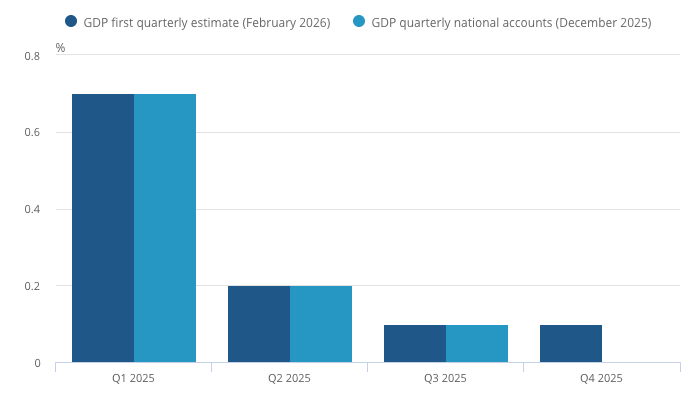
Source: ONS
A 1.2% increase in production helped offset the 2.1% drop in construction output, while the services sector output stagnated.
In the industrial sector, manufacturing output climbed 0.9%, utility output jumped 3.1% and mining and quarrying output rose 1.4%.
Expenditure side analysis of the growth showed a slowdown in household final consumption expenditure growth to 0.2% from 0.4%. The real government spending grew 0.4%, thanks to increases in health, public administration and defence, and social care. On the other hand, gross fixed capital formation edged down 0.1%, dragged by a 2.7% plunge in business investment.
ING economists said the steep drop in business investment may have to do with volatile car production, linked to a major cyberattack at the tail-end of the third quarter. Some of the drop may also have been due to the wider uncertainty in the run-up to the Budget and the weakness in business confidence, they added.
On a year-over-year (YoY) basis, the fourth-quarter GDP grew 1%, while economists braced for a steady pace of 1.2% growth. The economy expanded 1.3% YoY in 2025 versus the 1.1% growth in 2024. Real GDP per household climbed 1% following no growth in 2024.
The Bank of England’s (BoE) Monetary Policy Committee (MPC), which met last week, kept the Bank Rate unchanged at 3.75%, with the decision a closer call than had been expected.
Economists Warn of Tougher Road Ahead: “We think 2026 will be weaker than 2025 – though not dramatically so,” ING economists said. The economists expect flat disposable income growth, and inflation to fall dramatically, likely dropping from 3.4% in December to 1.8% in April, where it will more-or-less stay for the rest of the year.
That said, the economists are skeptical of meaningful consumption growth as wage growth was falling rapidly.
Will BoE Lean Dovish? ING also braced for rate cuts in the near term. “If the recent weakness in hiring/unemployment, coupled with rapid falls in wage growth, persists over the next couple of readings, then we think a March rate cut is highly likely. We expect another cut in June,” it stated.
GBP Holds up….but How long? As the U.K. economy is expected to be stuck in a low growth, disinflation phase, sell GBP trade could be the way forward for futures traders in the near term. The GBP futures (6B) has been in a broad consolidation phase for nearly a year now. If the derivative contract does not hold support around the 1.36 area, it could drop to the 1.3520 zone. On the upside, it has resistance around the 1.38 and 1.42 zones.
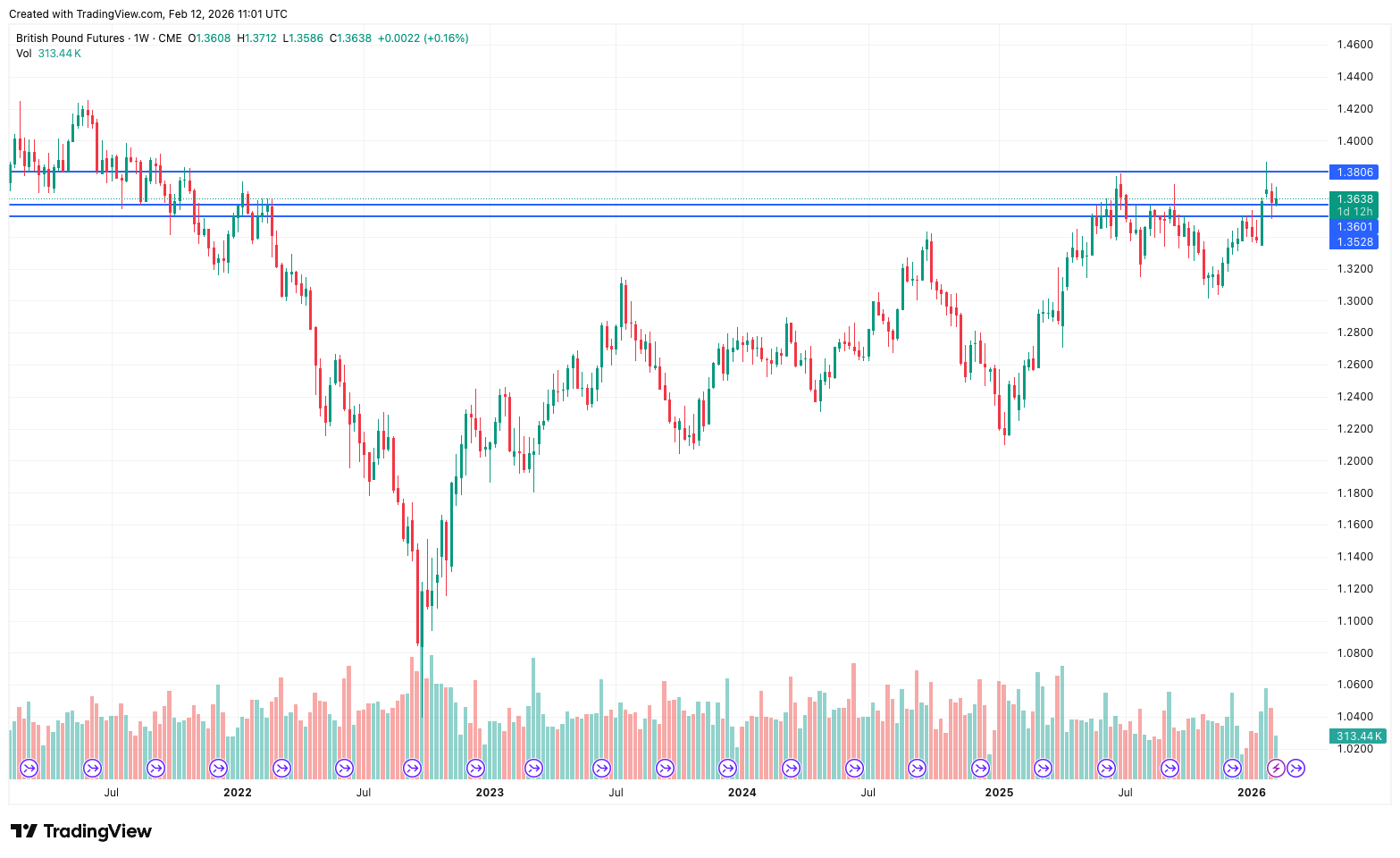
Source: TradingView
For futures traders, if the GBP futures (6B) breaks below the key consolidation support near the 1.36 zone, potentially opening downside toward the next support area around 1.3520, based on recent price structure. On the upside, any rebound that holds above 1.38 would weaken the immediate bearish setup.