
The International Energy Agency (IEA) reduced its oil demand forecast for 2026 in its latest monthly Oil Market Report (OMR) released on Thursday.
Crude oil futures contract (CL) trading on the CME Group’s New York Mercantile Exchange (NYMEX) fell on Thursday, giving back some of the gains from Wednesday, when it climbed on strong U.S. monthly non-farm payrolls data. Wednesday’s gains came despite crude oil inventories rising for the third straight week in the U.S., as per the Energy Information Administration’s (EIA) weekly Petroleum Status report.
Demand Outlook Tempered: Paris-based agency now expects global oil demand to rise by 850 Kilobarrels/day (kb/day) in 2026, down from its 930 kb/day estimate in January. Nevertheless, demand is likely to increase from last year’s 770 kb/day estimate.
The IEA said non-OECD countries, especially China, would drive much of the upside. It sees petroleum feedstock products accounting for more than half of the year’s gains, up from the one-third they accounted for in 2025.
After a nearly 20% drop in 2025, CL is up 13% so far this year. The one-year CL chart shows bullish technicals, with the shorter-term 50-day simple-moving average (SMA) poised to cross over above the longer-term 100-day SMA.
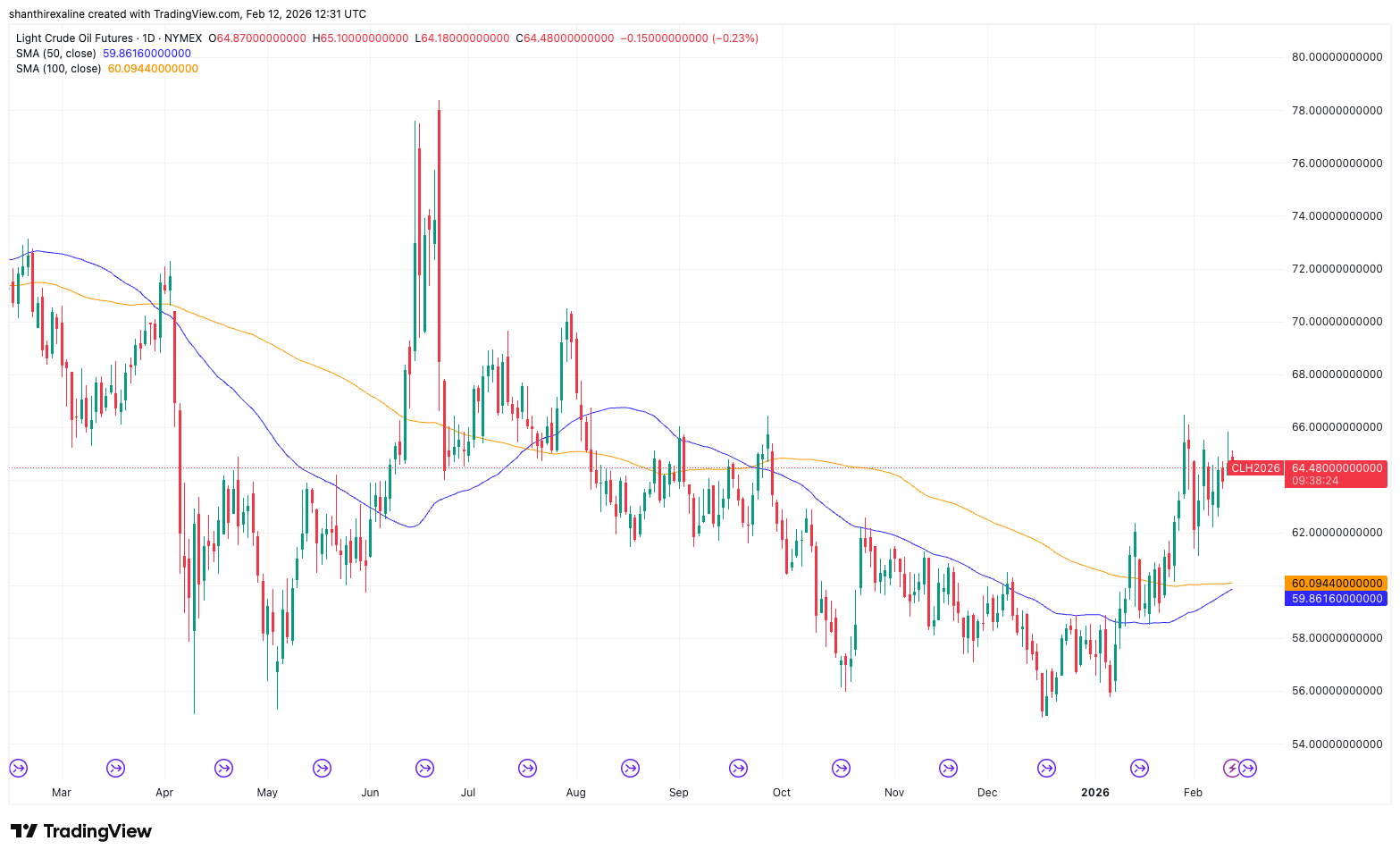
Source: TradingView
January Crude Market Dynamics: IEA said world oil supply plunged by 1.2 million barrels per day (mb/day) in January due to supply chain disruptions stemming from severe winter weather disruptions in North America, outages and export constraints in Kazakh, Russian and Venezuela.
The agency now expects world output to rise by 2.4 mb/day in 2026 to 108.6 mb/day, with the daily production expected to slow down from 3.1 mb/day in 2025. The growth will be split evenly between OPEC+and OPEC producers.
IEA’s preliminary estimates for January showed a 49 million-barrel rise in observed global oil inventories, up from the 37 million-barrel increase in December. In 2025, the total inventory build was at 477 million barrels, translating to 1.3 mb/day, marking level not seen since 2020.
On the pricing front, IEA noted that the North Sea Dated crude oil prices rose by over $10/barrel in January due to escalating geopolitical tensions, snow storms and extreme temperatures in North America, and Kazakh supply disruptions.
Read Next: UK Q4 GDP Miss Keeps BoE Cut Bets Alive: GBP Futures Hold 1.36 Support Despite Weak Data