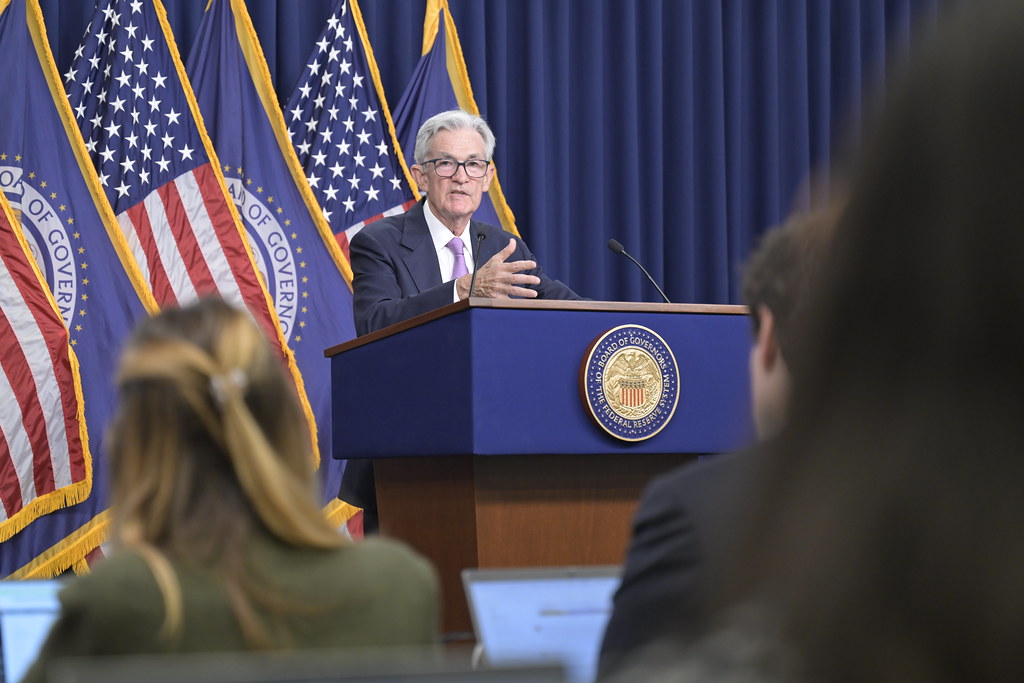
Federal Reserve Chair Jerome Powell said he would prefer to wait and watch the impact of the ongoing U.S.-Iran war on the economy and inflation. The central bank chief's comments came as part of a moderated discussion with the Harvard University’s introductory Principles of Economics class on Monday.
Wait-and-See: “We feel like our policy's in a good place for us to wait and see how that turns out,” Powell said. The views expressed aligned with what he said at the press briefing that followed the February monetary policy meeting in which the Fed held the benchmark Fed funds rate unchanged at 3.50%-3.75%.
He also said the tendency of the central bank is to look through supply shocks. “Monetary policy works with long and variable lags, famously, and so, by the time the effects of a tightening in monetary policy takes effect, the oil price shock is probably long gone and you're weighing on the economy at a time when it's not appropriate.”
The central bank chair opined that inflation expectations remained “well anchored” beyond the short term. “But, nonetheless, it's something that we will eventually maybe face the question of what to do here; we're not really facing it yet because we don't know what the economic effects will be, but we'll certainly be mindful of that broader context when we make that decision."
Inflation Trajectory: The Fed chair expressed confidence in getting inflation to the 2% target on a sustained basis. “We had pretty much gotten there in 2024,” he said, adding that the labor market was at full employment at that time, essentially suggesting a soft-landing scenario.
Powell called tariffs as a smaller source of inflation and said the Fed sees it as a one-time price increase. He quantified the tariff’s impact as a half-to-one percentage point addition to inflation, which is very small compared to the pandemic era pricing pressure.
Conflict in Dual Mandate: Powell also acknowledged that there’s tension running between the central bank’s dual mandate: maximum employment and stable prices.
"We're looking for connections to the banking system and things that might, you know, result in contagion. We don't see those right now.”
“There’s sort of downside risk to the labor market, which suggests keep rates low, but there’s upside risk to inflation, which suggests maybe don’t keep rates low,” Powell said. “To try to expect unanimity at a time like that, where it’s really quite historically challenging, it would almost be misleading.”
Private Credit Market: Powell also shed light on the stress seen in the private credit market. “I'm reluctant to say anything that suggests that we're dismissive of the risk," he said. "We're looking for connections to the banking system and things that might, you know, result in contagion. We don't see those right now,"