
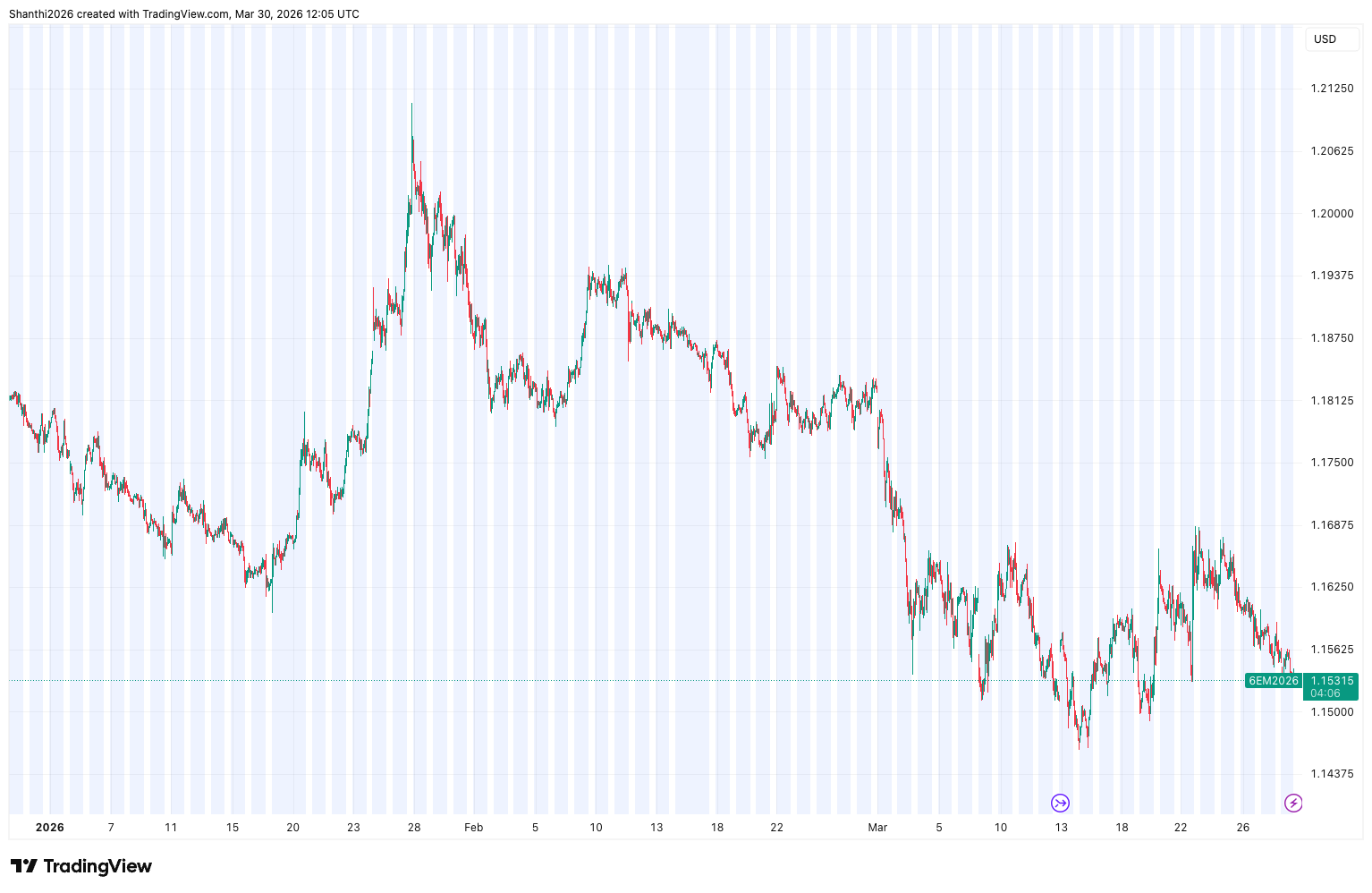
The Euro Forex futures (6E) continued to grind lower on Monday despite sentiment surveys showing a worsening outlook amid the latest geopolitical threat from the Middle East.
The data was collected between March 1-24, a period following the onset of the war between the U.S. and Iran that sent prices of commodities, especially energy-related, spiking higher due to supply-chain disruptions.
The contract tied to the Euro Forex futures, has been in a broader downtrend since it peaked above 1.21 in late January, and the latest data did little to alter the course.
Euro Forex futures (YTD Chart)
Source: TradingView
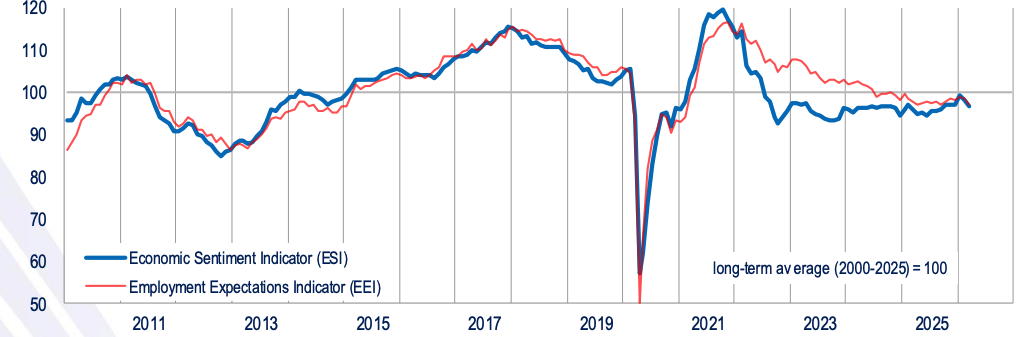
Confidence Recedes: The business and consumer March survey results released by the European Commission (EC) showed the economic sentiment indicator fell 1.6 points to 96.6 in the euro area, a region comprising 21 economies that share the euro as the common currency. The measure for the broader European Union (EU), a political and economic union of 27 European countries, also slid 1.5 points to 96.6.
The Employment Expectations index also declined 1.3 points for the EU and 1.4 points for the euro area.
The EC said both the indicators have now moved further away from their long-term average of 100.
Economic Sentiment & Employment Expectations
Source: European Commission
Among constituent countries, confidence waned the most in France and Spain, while the Netherlands and Italy also saw declines in sentiment.
The EC blamed the deteriorating economic sentiment to the weaker confidence among consumers and retailers, and to a lesser extent among service managers.
How constituent indices fared:
- Consumer confidence fell by 3.4 points to a 2-½ year low, dragged by a dramatic decline in consumers’ expectations for the overall economic situation in their countries
- Retail trade confidence fell 2 points as their business expectations for the next 12 months plummeted.
- Services confidence edged down 0.4 points.
- Industry confidence edged up 0.2 points.
Prices Become A Growing Concern: Managers’ selling price expectations rose sharply in all four business sectors, particularly so in industry, and moved beyond their long-term average. While consumers’ perceptions regarding prices in the past two months rose only moderately, their expectations about price developments for the next twelve months increased significantly.
The Economic Uncertainty Indicator (EUI) rose considerably, up by 3 points.
What Economists Say: ING Chief Economist for Netherlands, Bert Colijn said the Middle East war has clearly thrown the eurozone economy off track. Rising inflation expectations haven’t affected the output of businesses yet but expectations of higher selling prices and weaker demand have already filtered through to businesses, he said.
“A relatively quick end to the conflict would limit the economic fallout of course, but concerns about longer-lasting effects are clearly starting to affect the mood in Europe.”