Crude oil pressed ahead on Friday despite President Donald Trump taking another step back and extending the pause on military action on Iran. The Islamic nation’s continued defiance has unsettled the financial markets and eroded any remaining risk appetite.
The ICE-traded Brent crude futures (LCO) contract meant for May delivery climbed over 3% to $111.41 going into the New York session. The contract, however, trades shy of the $119+ level seen immediately after the onset of the war. Meanwhile, the CME-traded West Texas Intermediate (WTI) futures contract (CL) topped $97 a barrel.
Brent Crude Futures Intraday Chart
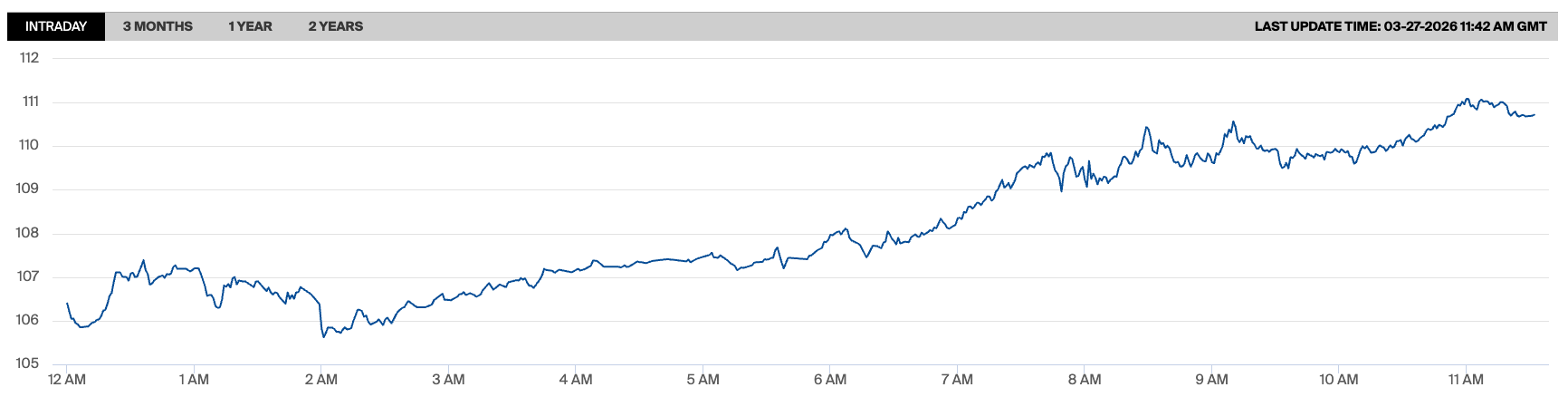
Source: ICE
Trump Blinks but Iran Doubles Down: The chatter about “Trump always chickens out” (TACO) has returned as the president extended the deadline for Iran offensive one more time. In a post on his Truth Social account late Thursday, the president said, “I am pausing the period of Energy Plant destruction by 10 Days to Monday, April 6, 2026, at 8 P.M., Eastern Time,” citing ongoing talks.
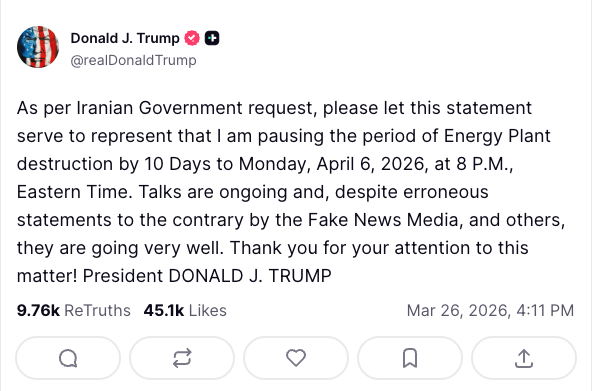
This follows a five-day pause announced Monday, replacing an earlier 48-hour deadline set on March 21 for reopening the Strait of Hormuz, a critical global oil chokepoint.
Subsequently, the U.S. presented a 15-point plan to end the war, using Pakistani Army General Asim Munir as the interlocutor. Iran refused to budge and shot down the proposals.
But Iran would not have any of it. While Trump said the 10-day pause was at the behest of Iran, leaders of the country squarely refuted the claim. In a post on X on Thursday, Iranian Parliament Speaker Mohammad Baqer Qalibaf said, “Your [people’s] 25 nights of presence in the streets and the sacrifices of the armed forces have created the conditions for a historic victory for dear Iran. No one can issue an ultimatum to Iran and the Iranian people.”
A New York Times report, citing state-run English broadcaster Press TV said Iran has come up with its own set of proposals, including a wider ceasefire for the region, reparations of war damage and the recognition of Iranian sovereignty over Hormuz. The U.S., meanwhile, has reinforced its military presence in the region.
With the war entering its 28th day, no resolution is in sight. The nearly month-long war has disrupted the global supply chains, ranging from energy commodities, fertilizers and food.
While Iran allowed passage of a limited number of tankers to transit via Hormuz, a sizable number of vessels are still stranded. Danish investment bank Saxo estimates that about 1,000 vessels, carrying oil, fuel and LNG, are still stranded in the Gulf due to elevated security risks and the withdrawal of war risk premium.
Analysts Skeptic: Supply disruptions continue to be elevated, said ING Commodities Strategists Ewa Manthey and Warren Patterson.
“Extending the ceasefire takes some near-term heat out of the market, but risks still lean to the upside. The scale of supply at risk remains significant – around 8 million barrels per day are already offline, and a much larger volume of flows through the Gulf remains vulnerable – so the geopolitical premium is unlikely to fade meaningfully.”
The strategists also noted that supply risks for the liquified natural gas (LNG) market have increased after a tropical cyclone forced production cuts at three Australian LNG plants, together accounting for around 8% of global supply.
The Strait of Hormuz closure and Iran’s strikes on Qatari liquefaction facilities have already pressured the market.
Citing Insights Global data, ING noted that ARA refined product inventories fell by 115 kilo tons (kt) week-on-week to 5.3 metric tons (mt) in the week to March 26, with gasoline, naphtha and fuel oil all declining.
Read Next:Iran War Dents German Business Sentiment Yet Euro Futures Stay Bid