
The latest monthly non-farm payrolls report released Wednesday showed stronger-than-expected job gains for January, tempering expectations of a rate cut by the Federal Reserve. Stock futures rose, bond prices fell, sending yields higher and the U.S. dollar rose in reaction to the report.
The CME FedWatch Tool showed futures traders pricing in a mere 5.9% probability of the quarter-point cut at the March rate-setting meeting, down sharply from 20.1% on Tuesday.
The release was brought forward from its usual first-Friday schedule due to a brief partial shutdown that began on Jan. 31, which disrupted operations at the BLS.
Solid Report… But Details Murky: The total non-farm payrolls for January came in at 130,000 versus downwardly job gains of 48,000 December, according to the results of the establishment survey by the Bureau of Labor Statistics. Economists, on average, expected job gains of 66,000 for January compared to the originally reported +50,000 for the previous month.
The November data was also revised lower by 15,000 to 41,000.
Here’s how the major sectors fared:
- Private payrolls: +172,000
- Goods producing: +36,000
- Service-providing: +136,000
- Construction: +33,000
- Private education & health services: +137,000
- Healthcare & social assistance: +123,500
- Government: -42,000
The manufacturing sector added 5,000 jobs, belying expectations for a loss of the same magnitude. BLS attributed the negative government payroll growth to some federal
employees who accepted a deferred resignation offer in 2025 coming off federal payrolls.
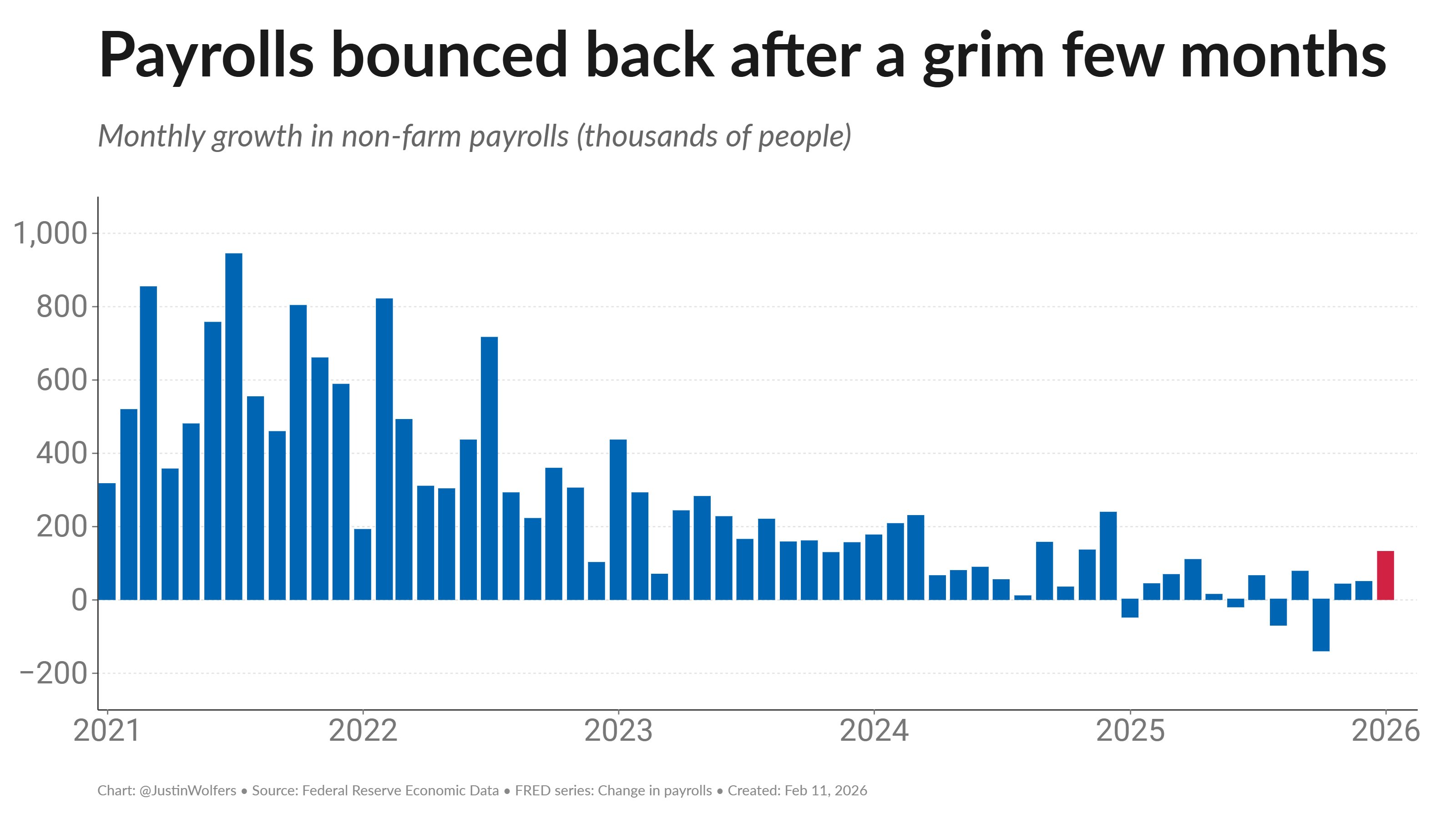
Source: BLS data via Justin Wolfers X feed
Commenting on the report University of Michigan economist Justin Wolfers said, “The U.S. job market is very unbalanced right now. One sector more than accounts for all jobs growth over the past year. The rest of the economy is shedding jobs.”
Jobless Rate Ticks Down: The unemployment rate based on the household survey fell to 4.3% in January from December’s 4.4%, and the number of unemployed was at 7.4 million. These numbers, although flattish with last month, marked increases from the year ago’s 4% and 6.9 million, respectively.
The U-6 unemployment, which also includes underemployed, marginally attached workers and discouraged workers, edged down 0.4 points month over month to 8%.
The labor force participation rate and the employment-population ratio stood little changed from the previous month as well as a year ago, coming in at 62.5% and 59.8%, respectively.
What NFP’s Inflation Reading Tells: The average hourly earnings rose 0.4% month-over-month to $37.17. On a yearly basis, the increase was 3.7%, flat with last month, but one-tenth of a percentage point higher than the consensus.,
Annual Benchmark Revisions: The final annual benchmark revisions to the non-farm payroll data for the 12-month period ending March 2025 showed a downward adjustment of 898,000. This nearly aligned with the 911,000 downward revision that was estimated on a preliminary basis in September last.
The change in total non-farm employment for 2025 was revised from +584,000 to +181,000.
Market Overlooks Inner Details: The futures market reaction suggests that traders see the data reinforcing the economy’s health, especially after Tuesday’s anemic retail sales data. Bonds and currencies traded on the premise that rate cuts would be held in abeyance.
- The U.S. dollar index futures (DX) spiked past 97 following the data but has since given some of the gains. At last check, DX traded up 0.22%.
- The 10-year T-note futures fell 0.29% as yield rose 4.3 basis points to 4.19%.
- The ES-Mini S&P 500 futures last moved 0.68% higher at 7,000+ level.
Read Next:Soybeans Futures Pop on China Talk in WASDE Report but Pullback Risk Builds