
While the world is focused on oil and derived product-related supply shock, a noble gas has become a quiet casualty of the US-Iran war that has been raging on for 13 days now.
Helium, an odorless, non-toxic, colorless and tasteless gas, is a non-renewable natural resource that is mostly recovered from natural gas deposits. Companies that drill for natural gas produce natural gas, process it and remove helium as a byproduct.
Supply Disruption: The U.S.-Iran war that began on Feb. 28 forced closure of state-owned QatarEnergy’s Ras Laffan Industrial City, which houses the firm’s natural gas processing and export operations. Following the plant’s closure on March 2, the firm declared force majeure, freeing itself from supply obligations to affected customers.
Qatar is among the biggest producers of Helium, second only to the U.S.
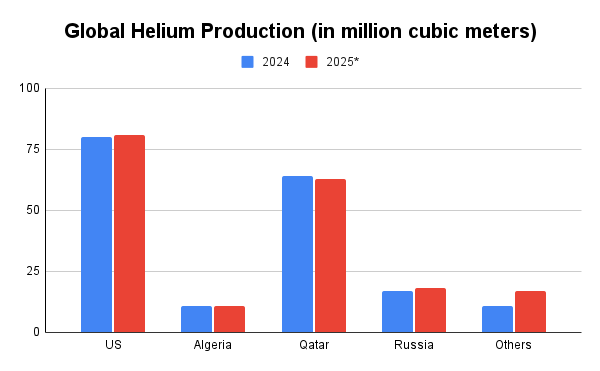
Data Source: US Geological Survey
*estimated
According to a C&EN report published last Friday, the facility extracts and liquefies up to 17 metric tons of helium per day. Citing helium consultant Phil Kornbluth, the industry publication noted that if QatarEnergy resumes production and is able to ship supplies through the Strait of Hormuz within about two weeks, the market could recover without much strain. A week has since elapsed, however, and the situation appears to have deteriorated.
Iran has intensified attacks on foreign vessels in the region, particularly those linked to the U.S., Israel and their allies. It has also targeted energy facilities in neighboring Gulf states.
So, what could be the fallout from a prolonged helium supply crunch? Helium has several industrial applications, including in semiconductor manufacturing. Semiconductors accounted for over one-fifth of global helium demand, the Gasworld stated in a Oct. 2025 report, adding that artificial intelligence (AI) chip manufacturing has driven the increasing utilization.
Apart from advanced chip manufacturing, helium is also used as a cooling agent and as shielding gas during fabrication of semiconductor wafers. The noble gas is also used in the production of high capacity hard drives.
The current supply has sent helium prices soaring. According to Kornbluth, president of Kornbuth Helium Consulting, spot prices of helium have doubled since the Iran war started, Reuters reported.
How Helium Supply Crunch Could Dent Semis: A March 2023 report from the Semiconductor Industry Association (SIA) stated that “Should the supply of helium be immediately disrupted, there would likely be shocks to the global semiconductor manufacturing industry.”
Helium has now come to become an essential component of the chip production chain, according to Bloomberg Intelligence analyst Michael Deng. The analyst sees memory chip prices soaring if the limited helium supply is diverted to AI memory chips.
South Korea, which has the world’s biggest memory chipmakers such Samsung and SK Hynix, is expected to be the worst hit as the country imports nearly two-thirds of its helium from Qatar, Tom’s Hardware reported. The memory chips made by these companies are used in electronic products such as smartphones and laptops.
In February, IDC forecast a 12.9% decline in smartphone shipments for 2026, and a more modest 11.3% drop for PCs.
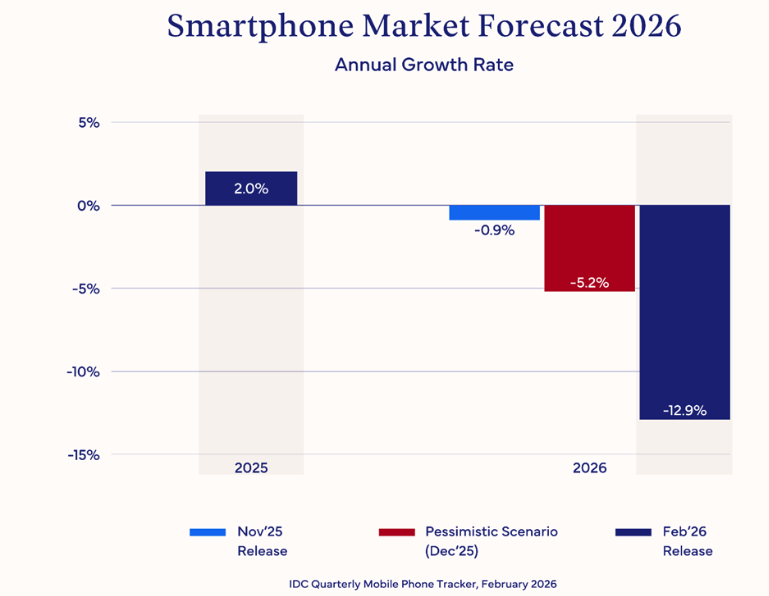
Source: IDC
The sour outlook is premised on memory chip supply challenges expected to persist through 2026 and into 2027. The firm expects memory chip prices to rise, albeit at a slower rate, in the second half of 2026, but stay elevated.
“The structural dynamics driving the shortage, surging AI infrastructure demand competing with consumer device needs for the same DRAM and NAND capacity, remain firmly in place.”
As AI-related demand for helium surge, consumer device manufacturers could face further downside supply pressure, driving up component cost and device prices