As crude futures head toward their best month ever, one more upside risk has emerged, adding fuel to the red-hot rally. Houthis, a Zaidi Shia military and political outfit in the West Asian country of Yemen, backed by Iran, have jumped into the fray, intensifying the Middle East war that has raged on for a month now.
New Threat Brews: The armed forces of Houthis stated that it has “carried out their first batch of military operation with a batch of ballistic missiles” targeting sensitive military targets of Israel, according to a statement on Telegram. The action was in retaliation against “continued military escalation” against allies such as Iran, Lebanon, Iraq and the Palestinian territories, it said.
The Israel Defense Forces (IDF) have since confirmed the development but said it has intercepted all attempted attacks. A spokesperson of the military reportedly said, “We are preparing for a multifront war.”
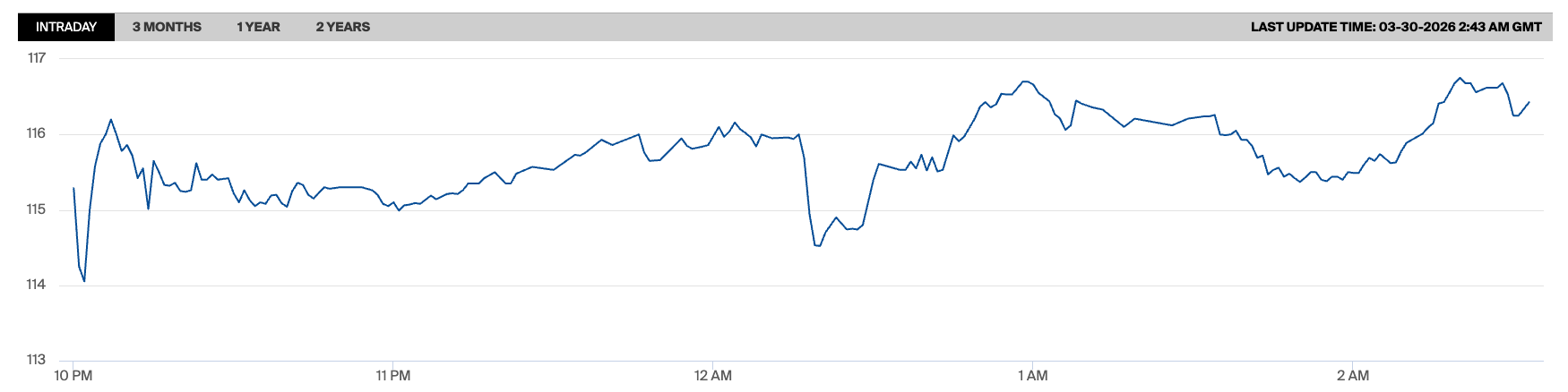
How Crude Reacted: Oil, which has been gaining ground since Wednesday last, took another leap as the futures reopened for trading in the Asian hours on Monday. The Intercontinental Exchange (ICE)-traded Brent crude May futures (LCO) climbed nearly 3.5%, topping $116-a-barrel.
The contract gained a whopping 60% in March, pushed higher by supply worries after the U.S., along with Israel, went to war with Iran over the latter’s nuclear pursuit. If the gains hold over Monday and Tuesday, the LCO contract is on track to record the biggest monthly advance ever.
ICE Brent Crude Futures (1-Day Chart)
Source: ICE
The West Texas Intermediate (WTI) contract has also gained over 3% to nearly $103, although off the $119.48 level seen on March 9 as traders factored in the supply chain impact following the war that broke out on Feb. 28. The U.S.-Israel war has already blocked much of the oil and natural gas flowing through the Strait of Hormuz, a main chokepoint.
To make matters worse, Iran’s retaliatory missile attacks on the energy infrastructure of fellow Gulf nations have taken some of the oil and refined products production offline.
Israel also began engaging with the Hezbollah militants in south of Lebanon following the later entering in the fray in support of its sponsor, Iran.
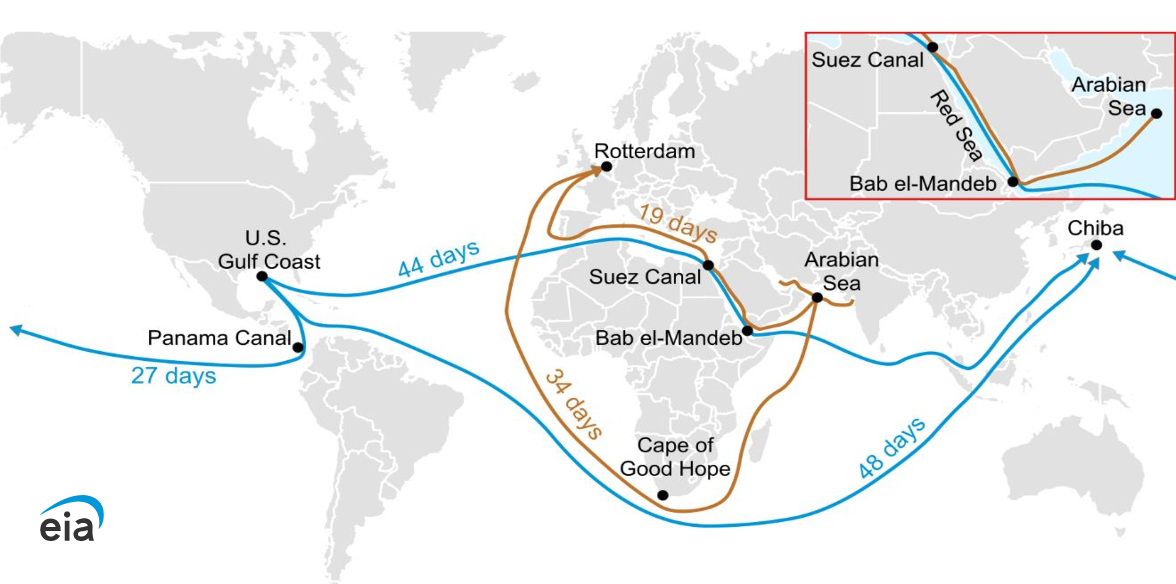
How Opening New Front Will Play Out: Ships transiting between Europe and Asia via the Suez Canal must pass through the Bab el-Mandeb Strait, which connects the Red Sea to the Gulf of Aden.When the Houthi movement targeted merchant ships transiting the Red Seas in late 2023, some vessels began to avoid the Bab el-Mandeb oil and natural gas chokepoint, a narrow strait that borders the Yemeni coast and serves as the south entrance to the Red Sea. They were forced to take the longer and costlier Cape of Good Hope route, increasing journey times by 10 to 14 days from Asia to Europe.
Commercial Shipping Routes
Source: EIA
For four tanker ships, the average month-over-month increase in the rates for transit through the Red Sea was 20% in December 2023, according to Argus Freight, EIA stated.
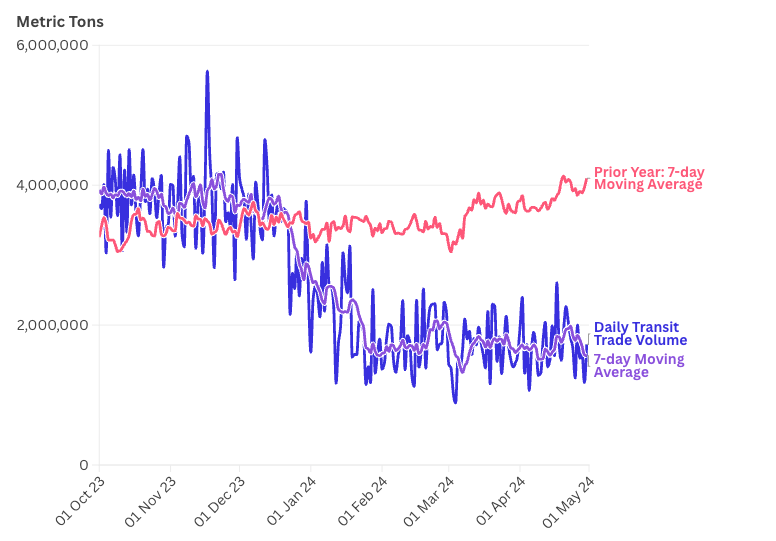
Traffic via the Bab al-Mandab Strait and the Suez Canal also reduced dramatically. The average daily transit trading volume slumped 57.5% to approximately 4 million metric tons towards the end of 2023 to a low of approximately 1.7 million metric tons at the beginning of 2024, the Atlas institute of International Affairs reported, citing IMF Portwatch data.
Suez Canal Transit Volume (Oct 2023 to May 2024)
Source: Atlas Institute
Analysts and strategists fear the current crisis would have deeper consequences. “Any sustained disruption will drive up shipping costs, increase oil prices, and place additional strain on a fragile global economy that is already reeling from the situation in the Strait of Hormuz," said Chatham House, an independent policy institute based in London.
“At the same time, vital economic and military infrastructure across the Gulf region may become increasingly exposed.”
The think-tank also sees more severe consequences if Houthis choose to expand their attack on Gulf Cooperation Council (GCC) members.