
Two separate manufacturing surveys showed that the U.S. manufacturing sector continued to expand in February despite the tariff turbulence and other uncertainties. The S&P 500 E-mini futures (ES), which traded sharply lower ahead of the data, recouped most of the losses thereafter.
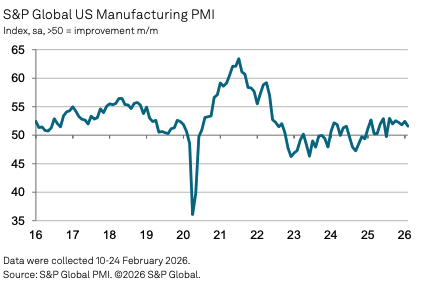
Expansion Continues - S&P: Final estimates released by S&P Global showed that the manufacturing sector continued to expand for a seventh straight month in February, although the pace of expansion slowed. The manufacturing purchasing managers’ index (PMI) came in at 51.6, upwardly revised from the 51.2 flash estimate released in mid-February. Nevertheless, it marked a decline from January reading of 52.4.
source: S&P Global
S&P Global said output and new orders buoyed the PMI but both metrics saw moderation in growth. Production rose at the slowest pace since September and volume of new work increased only marginally. The survey panel members found that tariffs and adverse weather weighed on both output and demand growth. Dented by tariffs, exports declined for the eighth straight month. While tariffs pushed up cost inflation, selling price inflation fell to a 14-month low as competition limited the pass through of costs to clients.
The survey also showed employment rose only fractionally due to manufacturers exercising restraint in hiring and a degree of excess capacity limited hiring as backlog of work declined.
S&P Global Chief Business Economist Chris Williamson said, “February saw US manufacturers report the weakest expansion since last July, in a further sign that the
overall pace of economic growth has moderated in recent months.”
The outlook, however, improved. Firms’ assessment of future output trends was positive and climbed to eight-month high due to expectations of new product launches and business expansion plans.
ISM Confirms Growth: A separate nationwide survey showed the sector expanded in February. The Institute for Supply Management’s (ISM) monthly survey revealed that the manufacturing PMI edged down 0.5 points month over month to 52.4 in February, although exceeding the consensus estimate of 51.7. Thus, the manufacturing sector expanded for a second straight month but it was only for the third time in 40 months.
The ISM stated that the overall economy continued to expand for the 16th month.
Here’s how the sub-indexes fared relative to January:
- New orders index: 55.8 (57.1)
- Production index: 53.5 (55.9)
- Prices index: 70.5 (59); This marked the highest reading since June 2022, when inflation peaked forcing the Fed to implement a series of rate hikes.
- Backlog of orders: 56.6 (51.6); marking the highest since May 2022
- Employment index: 48.8 (48.1)
- Supplier deliveries (which is inversed, i.e. a reading above 50 indicating slower deliveries): 55.1 (54.4); This, however, points to economic improvement and an increase in customer demand.
- Inventories index: 48.1 (47.6)
- New export orders index: 50.3 (50.2)
- Imports index: 54.9 (50); marking the highest since Feb. 2022
The ISM noted that the three indices of demand, namely new orders, backlog of orders and new export orders were in expansion in territory and customer inventories index remained “too low,” which is positive for future production.
ISM Chair Susan Spence said, “The Employment Index, though still in contraction, improved by 0.7-percentage point. However, 45 percent of panelists still indicate that managing head counts is the norm at their companies as opposed to hiring.
Sore Points Remain: The labor market, one of the two metrics which the Federal Reserve takes into account while formulating monetary policy, continues to show slackness. Inflation, the other important piece of the puzzle, spiked, especially the cost inflation.
Following the data, the odds of a Fed rate cut in March dropped to 2.6% from 7.4% that was seen on Friday, according to the CME FedWatch tool, which is constructed based on expectations of futures traders. The flare up in geopolitical tensions in the Middle East, which has caused a big spike in oil prices, may have also tempered expectations concerning a rate cut.