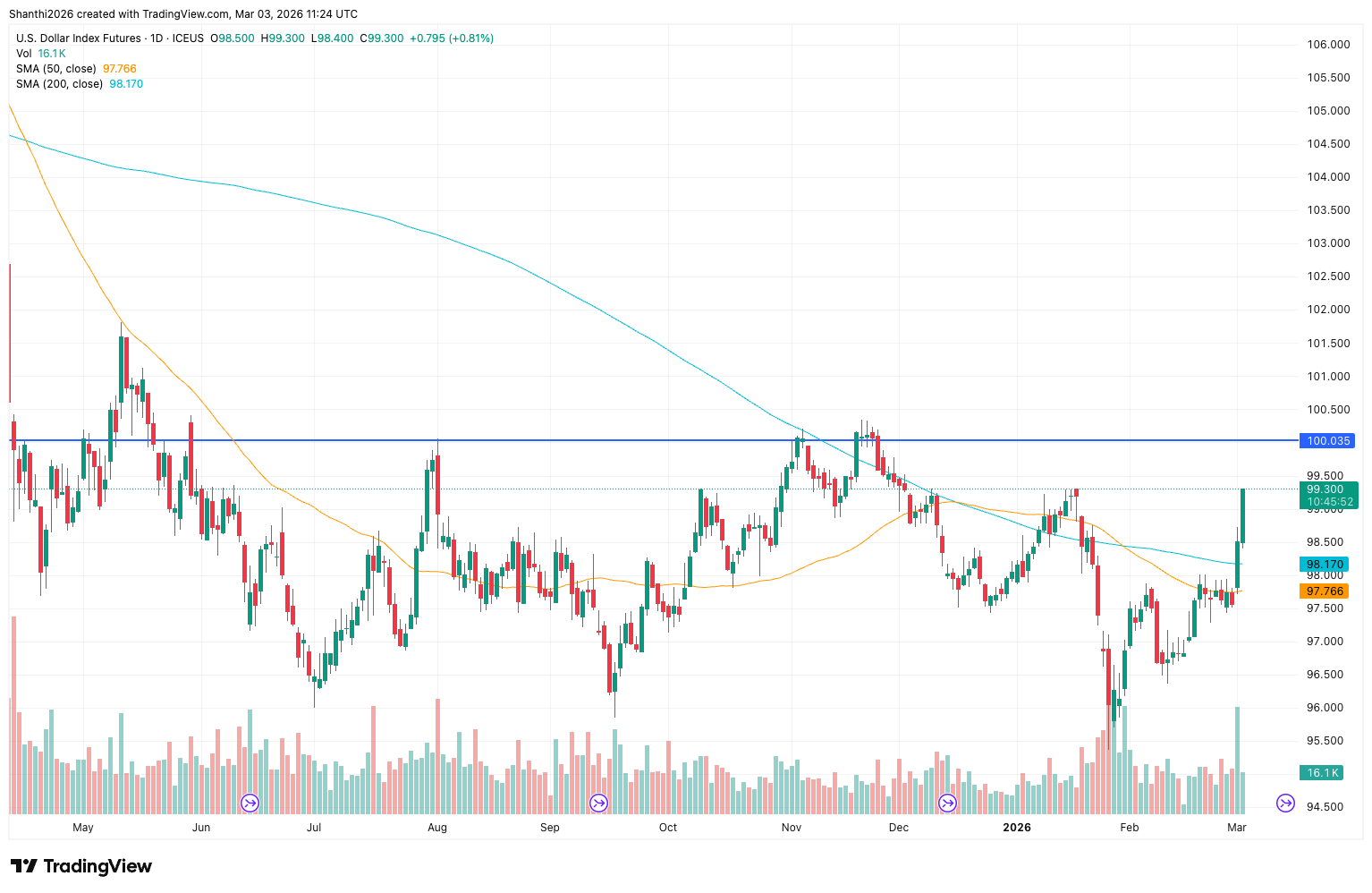
The U.S. Dollar Index futures (DX), which broke above the 200-day simple moving average (SMA) on a one-year chart on Tuesday, extended the gains in Tuesday’s session. The contract tied to the greenback has benefited from a surge in safe-haven demand amid the ongoing conflict involving the U.S. and Iran in the Middle East.
The forex futures also drew support from rising odds of a pause decision from the Federal Reserve at the March rate-setting meeting.
DX Retests 99 Mark: The U.S. Dollar Index, which ended last week at 97.57, added nearly 0.8% before settling at 98.34 on Monday, with the rally stoked by the weekend’s coordinated missile and drone strikes by the U.S. and Israel. The offensive led to the killing of Iran’s Supreme Leader Ayatollah Khamenei and also elicited counter attacks by Iran against several Gulf nations, heightening the regional tensions.
With both sides choosing not to back off, the conflict continues to escalate, keeping the safe-haven dollar bid. DX rose over 0.84% to 99.17 in the early New York session, the highest intraday level since Jan. 16. If the contract convincingly breaks above the 99.30 area, it could challenge the psychological 100 resistance next.
Source: TradingView
Rate Expectations Adding Momentum? Most recent data point to a resilient economy. After a year of abysmal job growth, non-farm payrolls expanded strongly in January. Private sector activity has also shown expansion, and the underlying inflation, although tracing a slowing trajectory, has remained above the central bank target for an extended period. The Middle East conflict could spawn additional inflationary pressure as crude futures are on track to record strong gains for a second straight session due to supply concerns,
The CME FedWatch tool, built based on expectations of futures traders, has put the odds of a rate pause at the March meeting at 97.3%.
Why Yen Futures Fell: The dollar strength has translated to weakness for the Japanese Yen Futures (6J). The contract, which allows futures traders to speculate on the value of the yen against the dollar, pulled back despite Japanese Government Bonds (JGBs) pulling back amid strengthening in yields.
The 10-year JGB auction held on Wednesday showed that the bid-to-cover ratio was 3.3 times, according to data provided by Japan’s Ministry of Finance. This was higher than 3.02 for the previous auction and the 12-month average of 3.23. The JGB also moved in tandem with the global bond yields as the crisis in the Gulf region aggravated inflation fears.
What’s Next For Forex Futures Market: The week’s key economic data are back-end loaded, and on Tuesday, speeches by a couple of Federal Reserve officials could set the tone for traders.