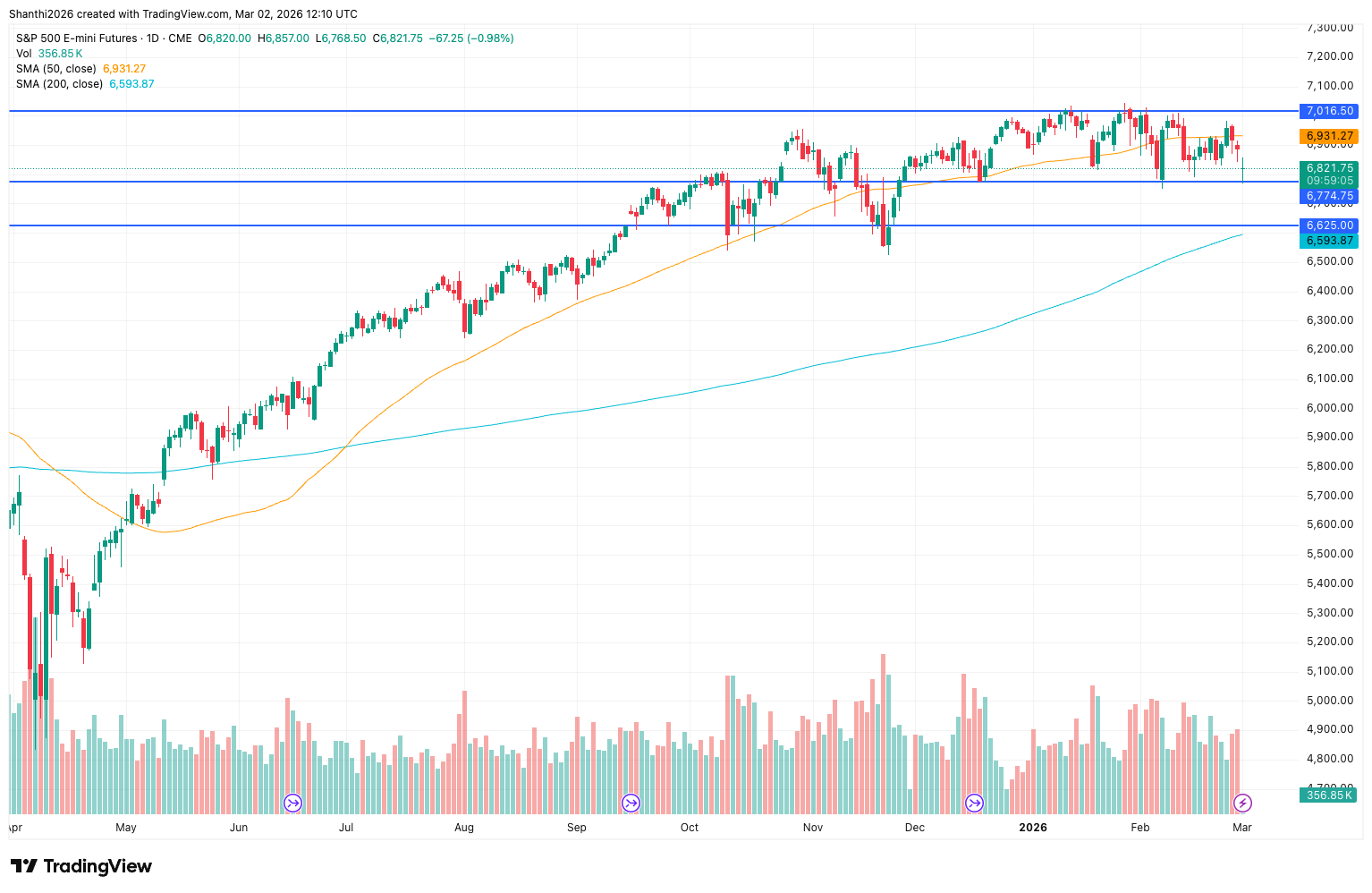
The ES contract tied to the S&P 500 Index, which has been rangebound since recovering from a late November sell-off, faces the risk of breaking below the trading range.
The trigger? The ongoing conflict in the Middle East involving the U.S. and Iran, which escalated over the weekend with airstrikes, bombings and killing of Iran’s Supreme Commander Ayatollah Khamenei, and retaliatory moves have left the global markets in a limbo.
ES Bounces off Key Support: The S&P 500 E-mini futures (ES) tested the lower bound of their trading range near the 6,775 level — a zone that has held since late November — on relatively strong trading volume. The contract has since staged a modest rebound, reclaiming the 6,800 handle, though it remains nearly 1% below Friday’s close.
Source: TradingView
Should risk sentiment deteriorate further amid escalating geopolitical tensions, ES futures could retest the 6,775 support zone. A decisive break below this level may expose the next downside target near 6,625, aligning with the lower boundary of a prior consolidation range.
Conversely, any signs of de-escalation in Gulf region tensions could help stabilize risk appetite, potentially guiding ES back into its established 6,775–7,016 trading range.
Strategies as Tensions Flare up: If ES stays within the broader range structure, futures traders could aim at mean-reversion or range-trading strategies. If the contract moves sustainably below the 6,775 level, with the downmove accompanied by heavy volume, it could accelerate toward the 6,625 mark. This could provide scope for short positioning.
That said, a relief rally cannot be completely ruled out in the eventuality of the geopolitical tensions abating. This in turn could set in motion a short covering-induced rally.
What Does Near-term Hold? If the regime change the U.S. and Israel are seeking doesn’t happen quickly, market discomfort will grow, Danish investment bank Saxo stated. This would especially so if Iran shows the capability of launching further attacks, be it military, energy infrastructure and even civilian assets, it added.
According to Saxo, “The status of shipping through the Strait of Hormuz is the most important single variable, but regional energy infrastructure like Ras Tanura in Saudi Arabia is also critical.”
Saxo’s Head of Global Strategy John Hardy said the best offense in times of uncertainty is defense and keeping overall market exposure modest. “For the nimble, an added approach is to keep some cash on hand to deploy once clarity emerges.”
At the same time, Hardy suggested not to panic and overcorrect as spikes of uncertainty most often resolves very quickly if the disruption clears.