Thursday’s Group of ten (G-10) central bank decisions played out in line with expectations, with the policymakers preferring to err on the side of caution rather than act preemptively. The U.S.-Iran war that began Feb. 28 has prolonged longer than anticipated, and has emerged as a key variable influencing the policy outlook.
Federal Reserve Chairman Jerome Powell shrugged off the inflationary impact of the crude oil shock as transitory in his press briefing that followed the monetary policy meeting on Wednesday. The Fed chose to keep the Fed funds rate unchanged at 3.50%-3.75% and raised its inflation estimates.
On Thursday, five more central banks followed suit and held rates unchanged:
ECB: The European Central Bank (ECB) kept its three key policy rates unchanged.
- Deposit rate: 2%
- Refinancing rate: 2.15%
- Marginal lending facility: 2.40%
The Governing Council stated that it wasn’t pre-committing to a particular rate path but suggested its future decisions will be based on its assessment of the inflation outlook and the risk surrounding it.
BoE: The Bank of England’s (BoE) Monetary Policy Committee (MPC) also maintained the status quo stance, keeping the bank rate at 3.75%. The central bank has cut rates six times since Aug. 2024. The central bank stated that “We are monitoring the situation very closely and will do what is necessary to make sure inflation stays on track to meet the target in the medium term.”
The BoE also underscored its readiness to act, as necessary, to keep consumer price inflation (CPI) on track to meet its 2% target in the medium term.
BoJ: The Bank of Japan (BoJ) also resolved to stay pat at its March meeting that concluded on Thursday. The decision to pause the uncollateralized overnight call rate at 0.75% was adopted by an 8-1 majority vote.
But the bank, under Governor Kazuo Ueda, left open the scope for future rate hikes, reasoning that the real interest rate remained at significantly low levels. But it hinged the upward adjustment to realizing the economic growth and inflation outlook presented in the January Outlook Report.
SNB: The Swiss National Bank (SNB) left its policy rate unchanged at 0%. It also stated that any sight deposits (the money held by Swiss banks with the SNB) above a certain threshold will earn an interest rate of 0.25%.
Riksbank: The Swedish central bank’s Executive Board also decided to keep the policy rate unchanged at 1.75%, adding that the rate will likely remain at this level for some time to come.
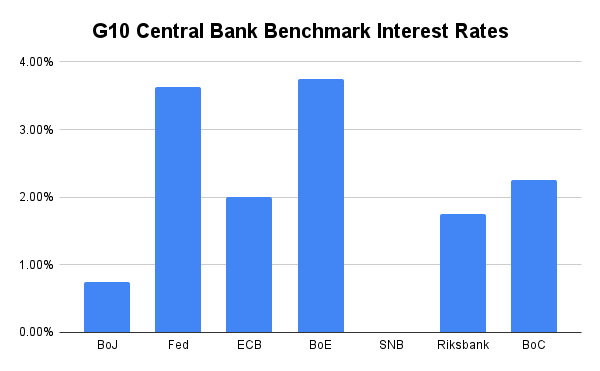
Data sourced from central bank websites
What did the G10 Central Banks say about the Middle East War?
- The ECB conceded that the war has introduced uncertainty, creating material upside risk for inflation in the near term and downside risk for growth. The medium-term implications depend on the length and the intensity of the war and how energy prices affect consumer prices and the economy. It, however, expressed confidence in its ability to navigate the uncertainty.
- The BoE said it remains alert to the increased risk of domestic inflationary pressures through the second-round effects in wage and price-setting, and also to the potential weakening of economic activity from higher energy prices. The central bank stated that “We are monitoring the situation very closely and will do what is necessary to make sure inflation stays on track to meet the target in the medium term.” The BoE specifically referenced the Dutch Title Transfer Facility (TTF) spot price, the European benchmark for natural gas prices, which spiked to over 50 euro per megawatt-hour (MWh), a 60% increase from pre-crisis levels.
- BoJ named the Middle East situation as risks to the outlook for growth and inflation.
- The SNB said its willingness to intervene in the forex market has increased due to the Middle East conflict so that it can counter excessive and rapid appreciation of the franc.
- Sweden’s Riksbank said its main premise was highly uncertain this time, and assumes that the war has moderate effects on inflation and the economic recovery. That said, it opined that it is still too early to be able to see clearly how the war is affecting the outlook.
How forex futures reacted to rate decisions: The yen futures have gained the most on the central bank-heavy day, although risk aversion may also have driven investors to the Japanese unit.
G10 Forex futures (1-Day Chart)
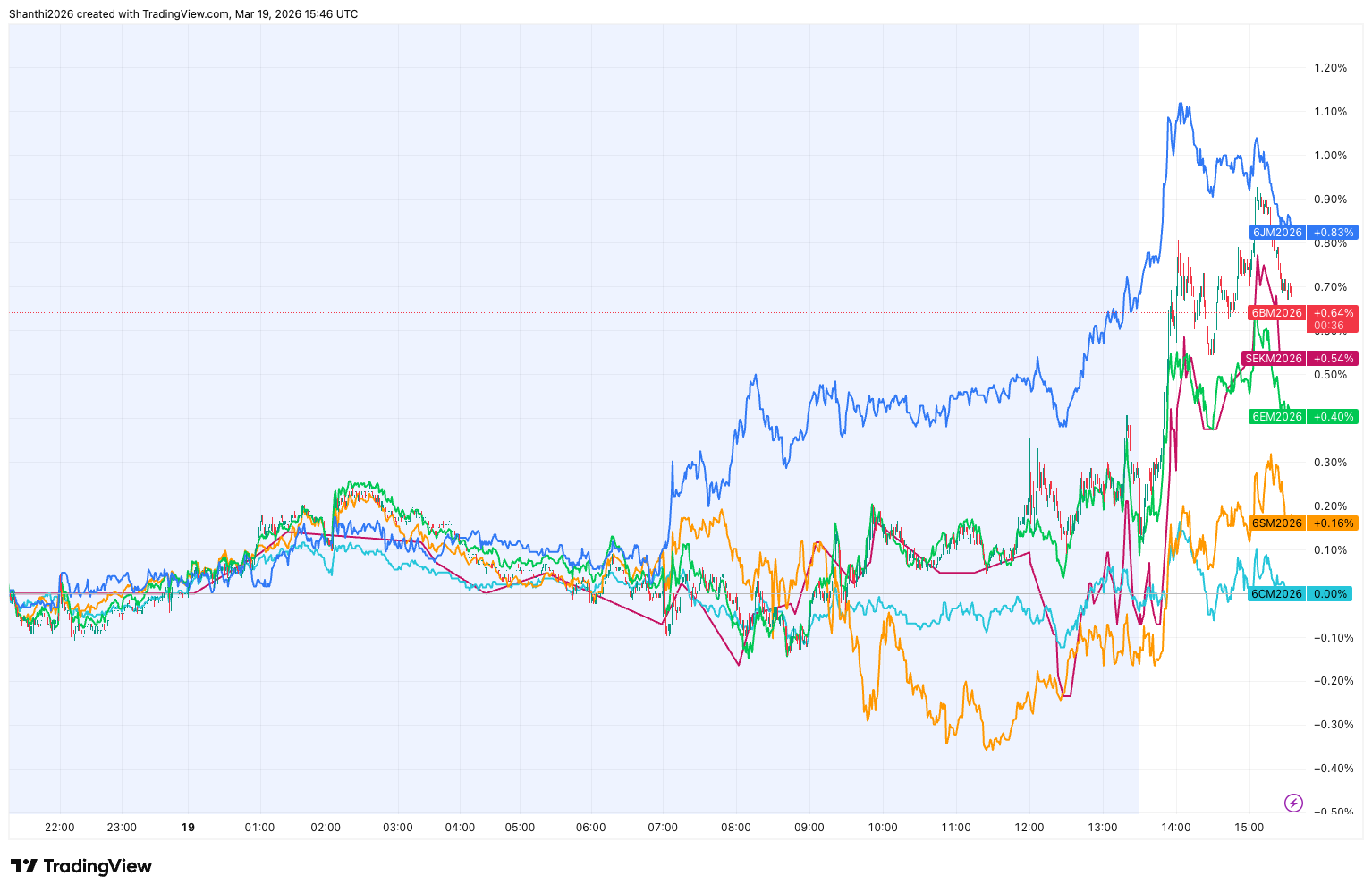
Source: TradingView
What Economists Say: ING Developed Markets Economist James Smith called the BoE decision as a “hawkish pause,” that has opened the door to future hikes if energy prices stay elevated. “Under ING's base case energy scenario, we think the most likely path forward is a prolonged pause.”
ING Global Head of Macro Carsten Brzeski sees the ECB in no hurry to raise rates despite remaining on alert due to the rise in oil prices. The strategist said, “In any case, at least at first glance, the current situation would qualify as a typical supply-side shock – which shouldn’t necessitate a monetary policy reaction.”
Following the BoJ rate decision, ING Senior Economist, South Korea and Japan, said, “The BoJ is unlikely to rush into raising rates. For now, we continue to expect a hike in June.”