
Bitcoin Futures (BTC) slipped under $65,000 on Monday for the first time since mid-October 2024 as the tariff uncertainty stirred by President Donald Trump’s tariff threats.
At last check, BTC slumped nearly 5% to around $64,800.
Trump Strikes Back: The Supreme Court struck down the tariffs imposed under the International Emergency Economic Powers Act (IEEPA) on Friday, and the president retaliated by announcing that he would hike the 10% global tariff to the maximum permissible percentage of 15% under the Sec 122 of the Trade Act of 1974. The section vests the president with the temporary authority to impose tariffs up to 15% without lengthy investigations and detailed reviews.
In a Truth Social post he also said, “During the next short number of months, the Trump Administration will determine and issue the new and legally permissible Tariffs.”
Risky Bets Tank: Bitcoin futures extended its recent lean run as the tariff uncertainty kicked off a risk-off trade, leading to a sell-off in risky bets such as equities and cryptocurrencies. On the other hand, safe-haven assets such as bonds, gold and silver rallied.
However, the U.S. dollar, often considered a safe-haven, pulled back, given the tariff threat suggested that the growth would suffer, giving the Federal Reserve leeway to cut rates.
BTC - What’s Next For Derivative Instrument? The Bitcoin futures rally stalled in early October after it hit a fresh peak ($124,070). It pulled back from the peak before going about a consolidation move between late November and late January. Renewed selling emerged thereafter. Saxo Bank attributes the fresh sell-off to uncertainty about the Fed’s rate trajectory that intensified after the nomination of former Fed official Kevin Warsh as a replacement for Chair Jerome Powell, the artificial intelligence (AI) and high-growth tech de-risking that generally weighed on the global risk appetite and the liquidity & deleveraging dynamics.
“When liquidity thins and leverage is reduced, an initial sell-off can become sharper and more self-reinforcing,” analysts at the bank said.
In a report released in early February, Saxo Bank had predicted a leg lower as a possible scenario if risk-off mood returns, when crypto behaves like a high-beta risk asset again. At that time, the bank stated that a break below $60,000 (early February low) would be a clear warning signal. If this level fails, the next technical reference zone sits at $53,000, which served as a consolidation or support range in earlier phases of the cycle.
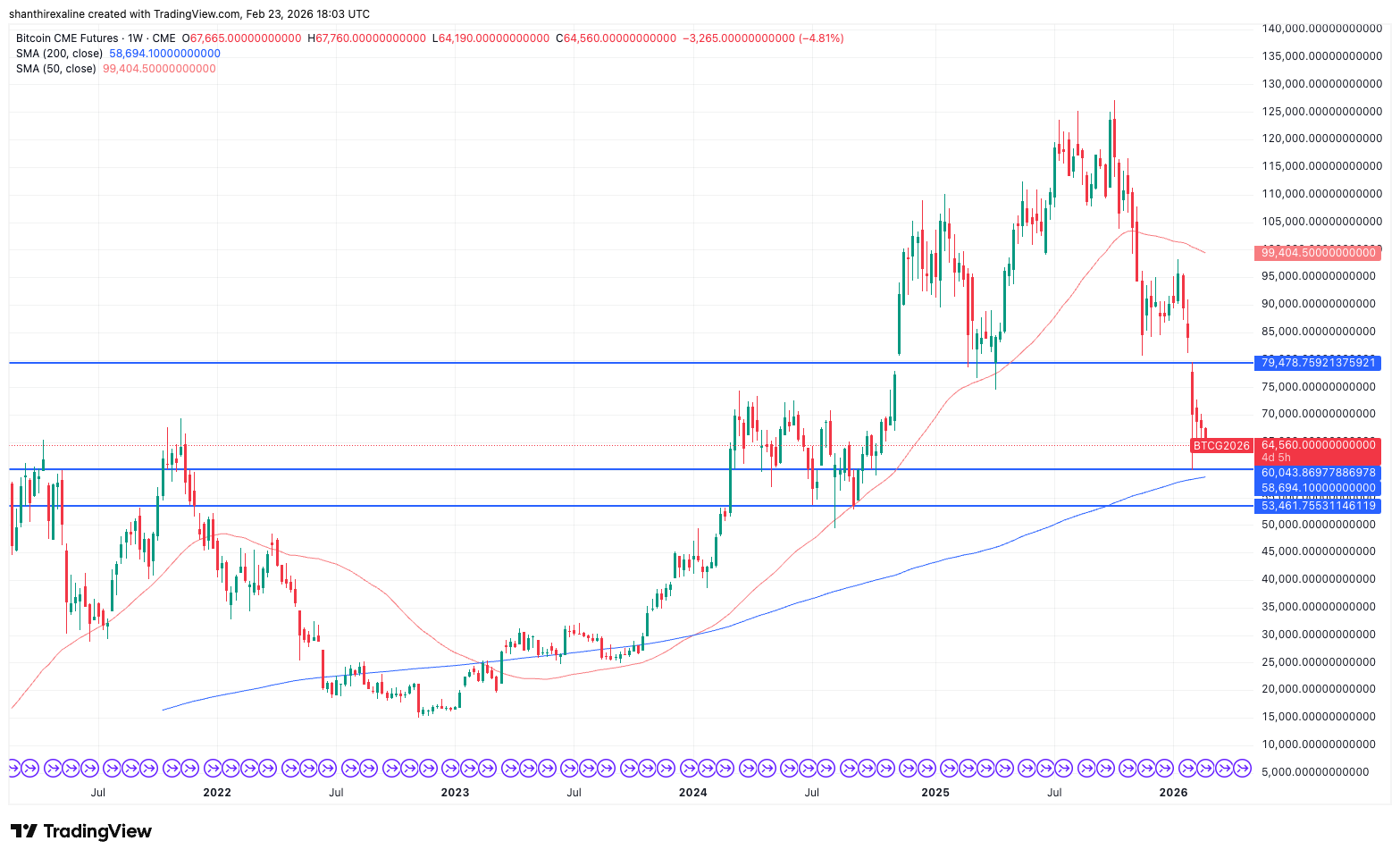
Source: TradingView
The crypto fear and greed index, compiled by Alternative.me is in extreme fear territory.
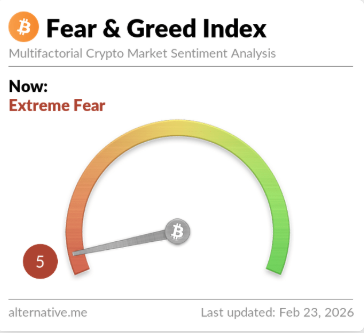
Source: Alternative.me
That said, Main Street banks have turned optimistic about cryptocurrencies. Morgan Stanley filed for a Bitcoin exchange-traded fund (ETF) in early January, and a Bloomberg report said JPMorgan was considering offering cryptocurrency trading to institutional clients.
In a report released earlier this month, JPMorgan strategist Nikolaos Panigirtzoglou said the firm is positive on the crypto markets for 2026 due to expectations that there would be a further rise in digital asset flow, led by institutional investors, according to Block.
Also, the Chicago Mercantile Exchange (CME) announced last week that, contingent on regulatory approval, it would allow regulated crypto futures and options trading for 24/7, beginning on May 29.
For now, tariff developments remain the key catalyst, and traders should brace for elevated volatility until greater policy clarity emerges.
Read Next: Fed’s Waller Sees March Cut/Pause as Toss-Up; Flags 2 Metrics as Deciding Factors