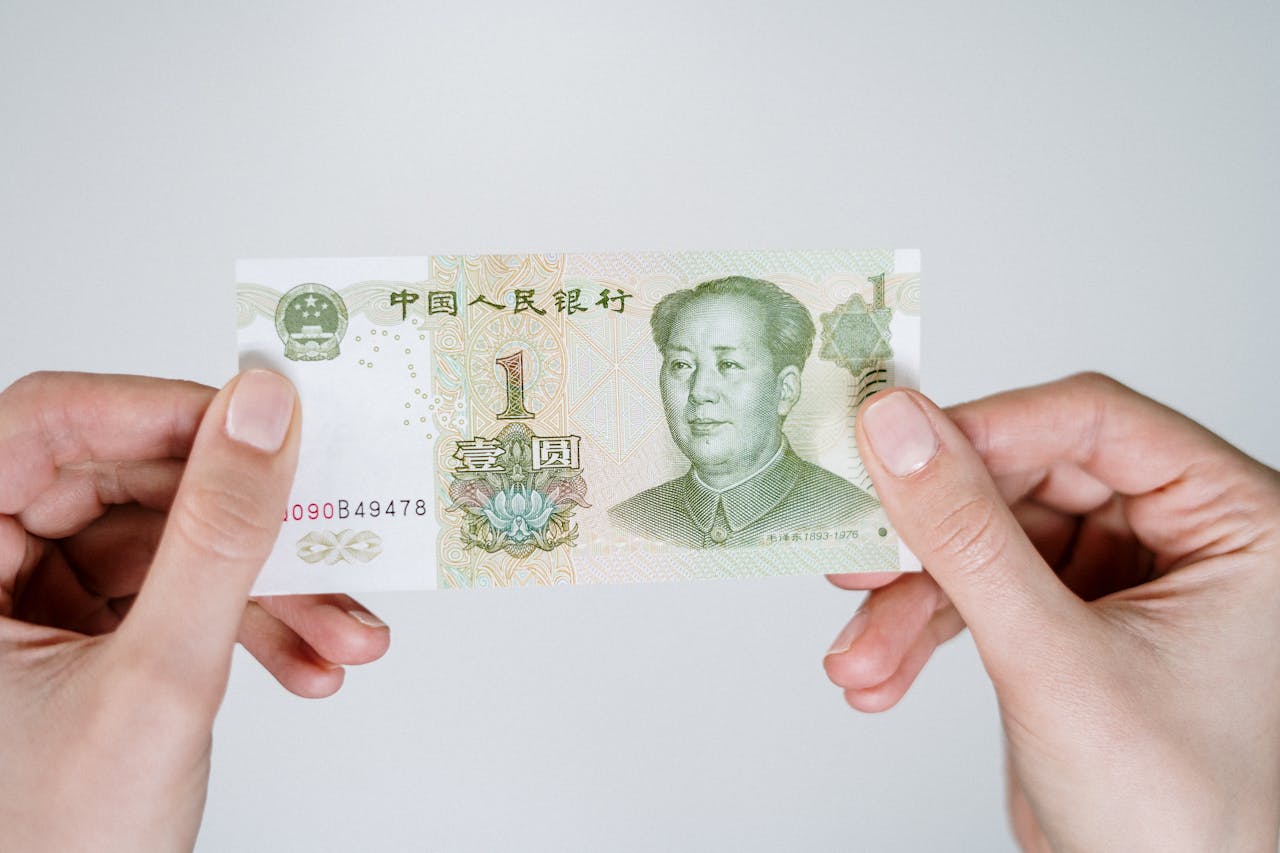
China’s central bank left key interest rates yet again on Tuesday even as the domestic economy’s momentum wobbles. The US Dollar/Offshore Chinese Renminbi (CNH) futures have edged lower, indicating modest yuan appreciation.
Post-holiday Moves: The People’s Bank of China (PBoC) kept the one-year loan primary rate (LPR) unchanged at 3% and the five-year LPR at 3.5%. The one-year LPR serves as the benchmark for most new and outstanding loans, while the five-year rate is used as the reference point for mortgages.
On Tuesday, the PBoC confirmed that it conducted seven-day reverse repo operations to the tune of 526 billion yuan ($76.14 billion) through quantity bidding at a fixed interest rate. This operation, which is used to adjust the amount of cash available to commercial banks, comes close on the heels of the reopening after a week-long Lunar New Year holiday break.
With 1.45 trillion of reverse repo maturing on Tuesday, the single-day net withdrawal was 926.4 billion yuan.
CNH’s Trajectory: CNH futures peaked near 7.43 in early April 2025 and have since slipped into a broader downtrend. On the five-year chart, a bearish death cross appears to be taking shape, with the 200-day simple moving average (SMA) moving toward a crossover below the 50-day SMA. Such a formation typically signals a shift toward sustained long-term weakness in the futures contract.
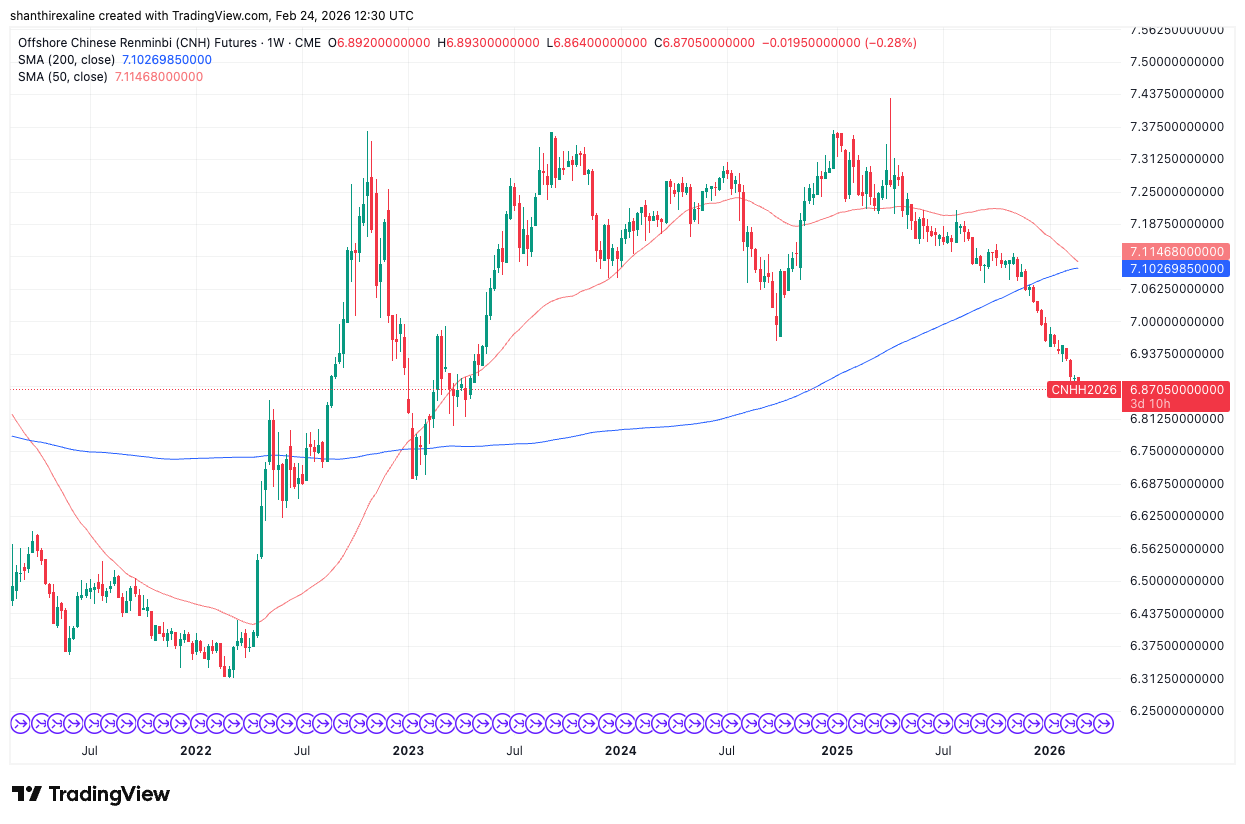
Source: TradingView
Yuan Outlook: With rates unchanged and a large net liquidity withdrawal (926.4B yuan), the PBoC signaled a neutral-to-tight liquidity stance post-holiday. This has supported modest yuan strength in the near term, pressuring USD-CNH futures lower.
Continued liquidity absorption and steady rates, along with stable exports introduce a bearish bias for the CNH futures. On the other hand, a surprise monetary policy easing, slower growth than has been forecast and a rebound in U.S. bond yields could prove bullish for the derivative instrument.
JPMorgan estimates that China, the world’s second-largest economy, is set to expand at a 4.1%-4.6% pace in 2026, slowing from 5% in 2025. The firm attributed the anticipated slowdown to the higher base for export growth.
Notwithstanding expectations for a deceleration in growth, the firm predicted in December that it does not expect meaningful policy rate cuts. Instead, it expects PBoC to rely more on liquidity operations and reserve requirement ratio (RRR) adjustments. At that time, the firm said the yuan is less likely to significantly appreciate in 2026. “While momentum could drive USD-CNH below 7 in the near term, over the medium term we expect a stable, range-bound trajectory for the pair,” it added.
Photo Caption: Bitcoin Futures Drop Below $65K as Trump Tariff Escalation Sparks Fresh Risk-Off Sentiment — Will BTC Defend Early February Support?