
The U.S. Dollar Index futures (DX) slid, while bond prices climbed, pushing yields lower, reacting to the Commerce Department’s retail sales report for December.
DX, which dropped below the 97 mark for the first time in a week on Tuesday, edged down, and the 10-year T-note futures (ZN) climbed 0.21%.
Read-across for consumer health: Headline retail sales remained unchanged in December relative to the previous month. Economists, on average, expected a 0.4% month-over-month (MoM) increase, slower than the 0.6% growth reported for November.
Auto sales edged down 0.2%, reversing some of the 1.2% increase in November, and gasoline station sales growth slowed notably to 0.3% from 1.7%.
On a year-over-year (YoY) basis, retail sales rose 2.4%, slower than the 3.3% increase in November.
Retail sales, excluding autos and gasoline, also remained unchanged following a 0.4% rise in the previous month.
Stripping off autos, gasoline, building materials and food services, the growth was down 0.1% versus a 0.2% increase in November. Economists had braced for a 0.4% growth for the month. This metric is important as it represents the cleanest measure of consumer spending, which directly goes into GDP calculations. Advance estimate of fourth-quarter GDP data, which pertains to the three months ended December, is scheduled for Feb. 20.
Data Vouches For Slowing Inflation: Fourth-quarter employment cost index released by the Bureau of Labor Statistics (BLS) showed a tamer 0.7% quarter-over-quarter (QoQ) increase in the employment cost index. Economists modeled 0.8% growth, the same pace of increase as in the previous quarter. Both wages & salaries and benefit costs climbed 0.7%. YoY, employment costs rose 3.4%.
A separate report released by the BLS showed that import prices edged up 0.1% month over month (MoM) in December, the same price of increase as in November. Export prices climbed a steeper 0.3%, faster than the 0.1% growth in November. Annually, import prices remained unchanged, while export prices climbed 3.1%. Both metrics slowed from the 0.1% and 3.3% increases, respectively, in the previous month.
Where Does This Leave The Rate Outlook? The CME FedWatch tool, which reflects traders’ expectations for the federal funds rate, now shows a 19.7% probability of a quarter-point rate cut at the Federal Reserve’s March 18 policy meeting, up slightly from 17.2% on Monday.
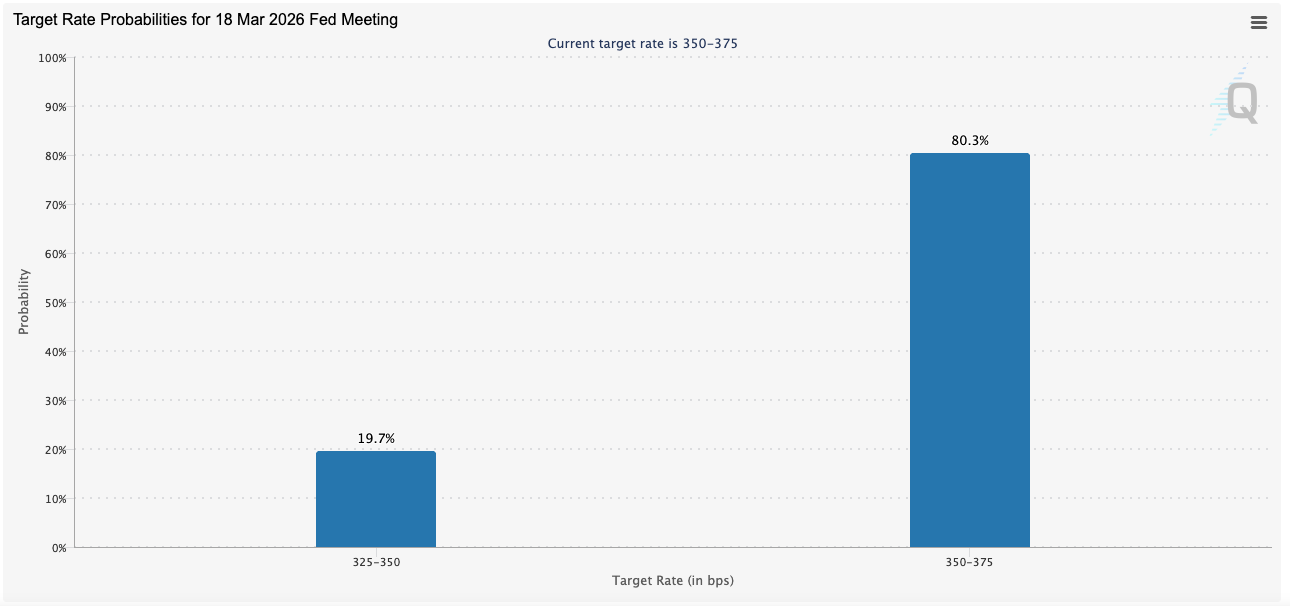
Source: CME Group
What Economist Says: As retail sales stalled, Northlight Asset Management Chief Investment Officer Chris Zaccarelli said, “Consumer spending has finally caught up with consumer sentiment, and not in a good way.”
After months of disappointing consumer sentiment readings, December retail sales data showed that “consumers are no longer relentlessly increasing their level of spending.”
“To the extent that the labor market holds up and consumers see more cash in their pockets from all of the pro-cyclical measures in last year’s OBBBA bill, then the economy can keep growing; but if this is a more permanent change in spending patterns then it could be the canary in the coalmine that signals a more serious slowdown.”
Read Next: WASDE Report due Tuesday: What Futures Traders Should Watch