The ongoing war in the Middle East between the U.S. and Iran has begun to weigh down on the sentiment of U.S. businesses, according to flash results released by S&P Global on Tuesday. That said, the market chose to focus on an acceleration in manufacturing activity, and as a result, risky bets gained ground following the report.
The U.S. business activity growth slowed to an 11-month low in March, dented by weaker new order growth and a spike in price. S&P Global Market Intelligence Chief Business Economist Chris Williamson said companies reported a hit to demand from the additional uncertainty and cost of living impact from the outbreak of the war in the Middle East.
The economists pointed to pressure on travel, transport and tourism sectors, alongside financial market volatility and rising affordability concerns, as key drags on overall sentiment.
Key numbers from the private sector survey:
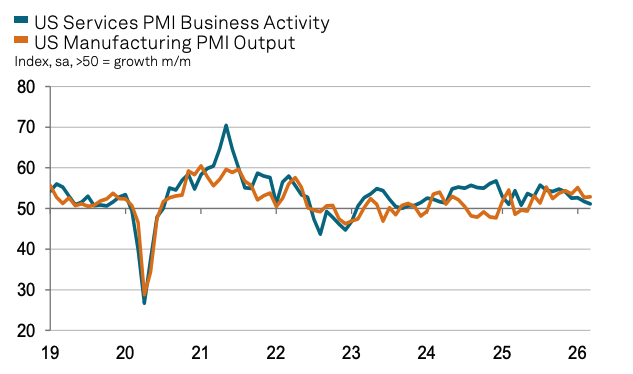
- The composite output index, referring to conditions in the manufacturing and services sectors, fell to 51.4 in March from 51.9 in February; This marked the lowest since April last year
- The manufacturing purchasing managers’ index (PMI), however, climbed to 52.4 in March from 51.6 in February, with improvement witnessed for the eighth successive month; consensus 51.5.
- The manufacturing output index edged up 0.2 points to a two-month high of 52.9 and new orders rose at the fastest pace in five months.
- Export orders received by manufacturing firms stabilized after declining for eight months.
- The services sector PMI business activity index dropped to 51.1 in March from 51.7 in February, also marking an 11-month low; consensus 52
US Private Sector Activity (PMIs)
Source: S&P Global
The slowdown in new orders bagged by the private sector was a function of a steeper loss of export sales due to subdued confidence among both consumers and businesses.
The expectations for output in the year ahead deteriorated slightly, although still running in line with the average seen over the past year.
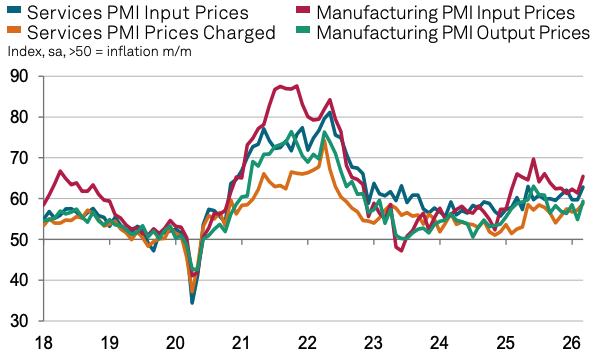
War Hits Prices, Supply Chains: The survey found that war-related shipping disruptions and stocking by firms lengthened supplier delivery times in March, with supply delays reported by more manufacturers than at any time since Oct. 2022.
Higher energy prices resulting from the war led to input prices increasing at the fastest pace in ten months. The survey also found that firms passed on higher costs to consumers, resulting in the largest rise in selling prices in over three-and-a-half years.
Prices Paid & Received
Source: S&P Global
The uncertain economic climate also led firms to trim jobs for the first time in over a year. Manufacturing jobs rose only marginally (weakest pace in eight months), while the services sector reported staffing declines.
Implications for Growth, Rates: Williamson said the flash PMI reading corresponds to annualized GDP growth of 1%, with a modest 1.3% growth likely in the first quarter. The U.S. economy grew at an anemic 0.7% pace in the fourth quarter of 2025, markedly slowing from the 4.4% pace in the previous quarter.
“The survey’s price gauges meanwhile point to consumer price inflation accelerating back to around 4%, hinting at a growing risk of the US moving into an environment of stagflation,” he said.
The Federal Reserve, according to the economist, faces an unenviable task of balancing the upside risks to inflation against the risk of the economic momentum losing steam.
How Markets Reacted: The E-Mini S&P 500 futures (ES) recouped some of the early losses following the PMI reports, although the contract continues to trade in the red, following Monday’s rebound. The 10-year Treasury Note futures (ZN) slipped as yields climbed.