The stock index futures traded modestly lower early Friday, signaling that they could tack on to the losses from the previous session. The weaker sentiment came amid crude oil futures (CL) holding firm above the $80 a barrel level and apprehension ahead of the all-important non-farm payrolls report that is due ahead of the market open.
At the time of writing, here’s how the major stock index futures traded:
- E-mini S&P 500 futures (ES): -0.27%
- Nasdaq 100 Futures (NQ): -0.38%
- Mini Dow Jones Industrial Futures (YM): -0.19%
- E-mini Russell 2000 Index Futures (RTY): -0.25%
Bond prices edged lower, sending yields higher amid the spike in oil prices, which is perceived to fan inflationary pressure.
Resolution Elusive: The U.S.-Iran conflict continues to escalate, with Tehran remaining defiant despite ongoing drone strikes and military attacks. Iran’s strategic leverage stems less from its own oil output and more from its geographic position along the Strait of Hormuz, a critical chokepoint through which roughly a fifth of global oil and LNG supplies transit.
Stagflationary Shock Loading? ING Global Head of Macro Carsten Brzeski said any new energy price crisis due to the war will be different from the scenario in 2022, when oil prices spiked above $100 per barrel, pushing up inflation at an accelerated pace. The strategist also sees the potential for a stagflationary shock for the global economy, posing a new dilemma for the central banks.
The investment bank assumes four weeks of disruption to oil and LNG flows, with two weeks of full disruption and two weeks of partial disruption. It expects Brent crude oil prices to average $71/barrel and TTF natural gas prices at 31 euros per Megawatts per hour (MWh)
Where Does This Leave the Path For Monetary Policy? ING’s Brzewski model U.S. inflation to overshoot 3% this year, exerting downward pressure on consumer spending and economic growth. The firm now pushed forward the timing of the Federal Reserve’s next rate cut to September.
The strategist also sees the European Central Bank (ECB) holding fire for now, factoring in slightly slower growth and somewhat higher inflation. However, he expects the Bank of England to cut rates at least in April, given the labor market remains under pressure. Brzewski also said a Bank of Japan can’t be ruled out.
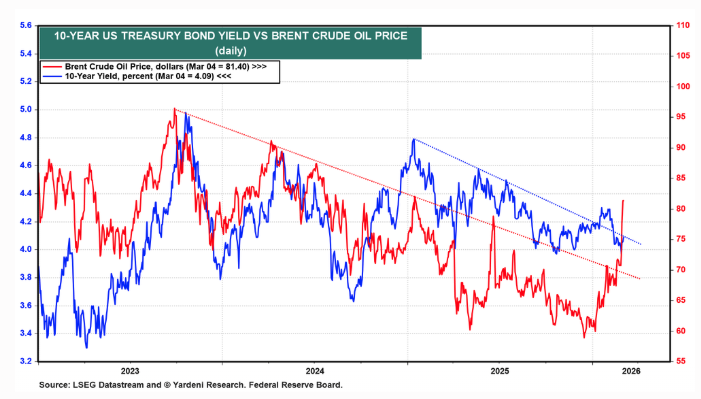
Strategist Ed Yardeni said, “The longer the war lasts, the more it will straitjacket the Strait of Hormuz, increasing the risk of stagflationary economic outcomes in the US and other countries.” He warned of a potential spike in inflation expectations due to rising energy prices, pushing up 10-year Treasury note yields. This would keep the Fed from cutting rates even if the economy weakens, he added.
10-year T-note yield Vs. Crude oil prices
Source: Yardeni Research
What This Means For Markets: Between now and the March 17-18 Federal Open Market Committee (FOMC) meeting, aside from Friday’s non-farm payrolls data, the market would receive the February inflation report and a couple of consumer confidence readings. The situation in the Middle East will also be closely watched by traders as they plot their next moves. The Fed officials go into a blackout period from Saturday until March 19.
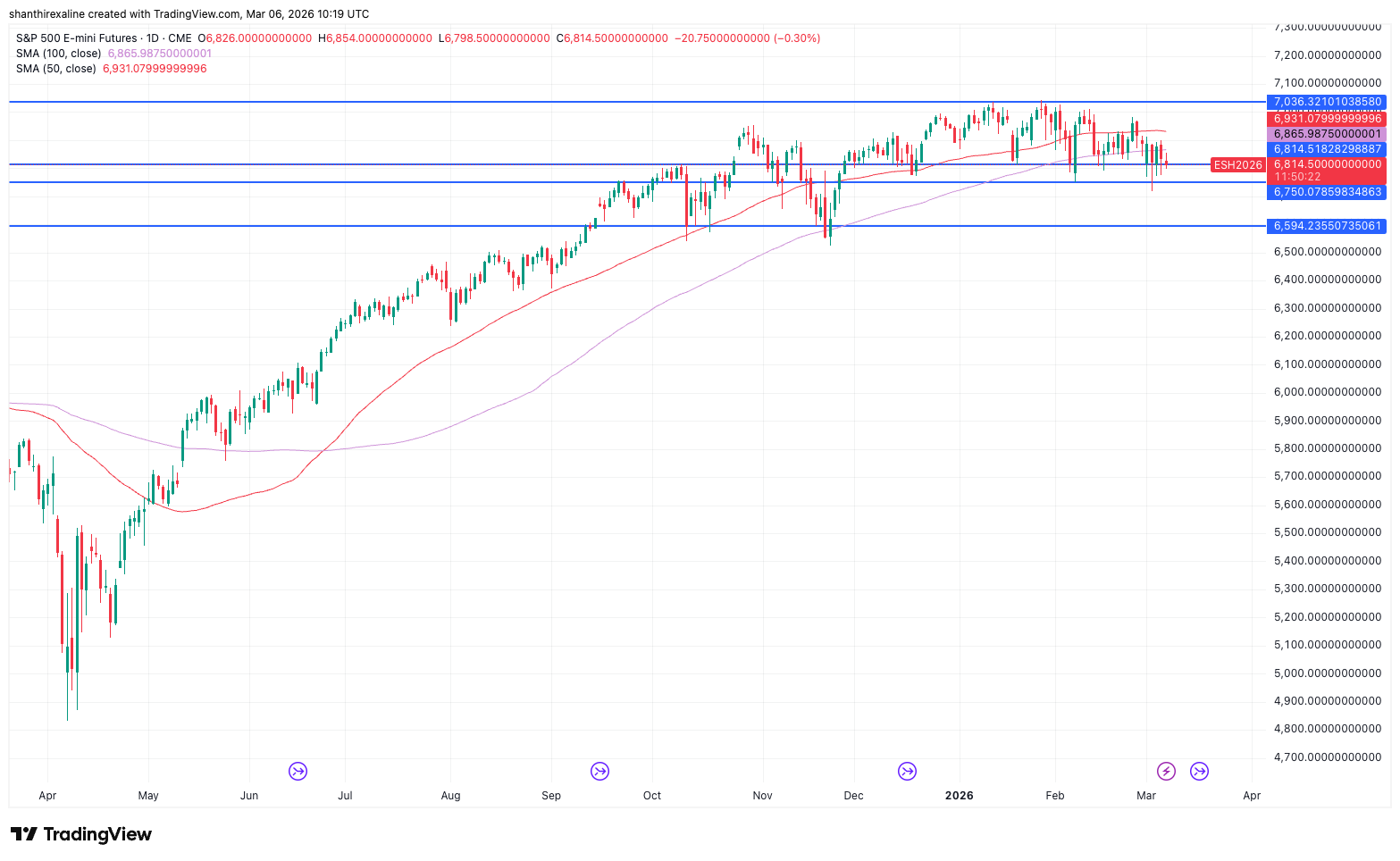
Taking the ES as a proxy for the U.S. equity market, the contract tied to the S&P 500 Index has been consolidating the 6,815-7,036 range. A decisive break below 6,815 could trigger momentum selling, opening the door for a move toward 6,812 initially and then 6,594, the next meaningful support zone.
Source: TradingView
On a one-year chart, ES is trading below the 50-day and 100-day simple moving averages (SMA) of 6,931 and 6,866. A sustained move above these key resistance levels could suggest strengthening upward momentum.
The oil shock linked to the Middle East conflict could heighten the market volatility, keeping traders on the tenterhook. Analyzing the options chain, Danish investment bank Saxo said there is a clear downside skew, with puts’ implied volatility around the money higher than comparable calls, signaling that investors remain focused on downside protection rather than chasing upside.
Read Next: Steady Jobless Claims, Falling Layoffs Signal Nascent Labor Recovery — Fed Rate-Cut Plans on Hold?