
Eurozone services activity picked up momentum in February, according to survey results released by S&P Global and Hamburg Commercial Bank on Wednesday. The composite purchasing managers’ index (PMI) for the 21-nation bloc sharing the euro as the common currency also pointed to accelerating activity.
Private Sector Holding Up: The services PMI climbed to a two-month high of 51.9 in February from 51.6 in January but the rate of expansion trailed the long-run average. Nevertheless, the index came in line with expectations and confirmed the flash estimate released last month.
Meanwhile, the eurozone's composite PMI, which is a weighted average of the HCOB manufacturing PMI output index and the services sector business activity index, edged up 0.6 points to 51.9 in February, marking the highest reading in three months. The metric aligned with economists’ expectations and the flash estimate.
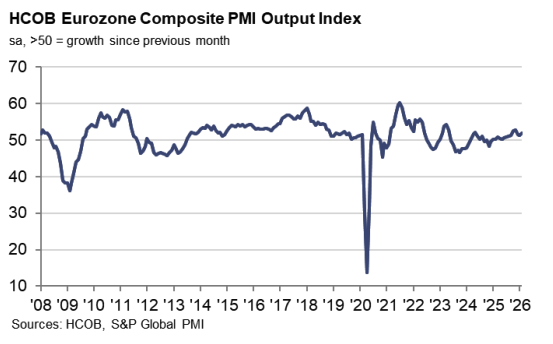
Source: S&P Global/HCOB
S&P Global/HCOB noted that Germany, the eurozone's largest economy, was the growth engine in the middle of the first quarter, recording the quickest upturn in four months.
HCOB Chief Economist Dr. Cyrus de la Rubia said, “The service sector did not perform particularly well in February, but momentum did increase slightly compared to the previous month.” New business increased at a slightly stronger rate and future business activity also showed improvement, the economist said.
The fact that companies hardly hired new staff on balance in the past two months underlined the overall subdued mood, he added.
He expects Germany to be the driving force of the eurozone economy in the coming months as additional spending on infrastructure and defence has had a positive economic impact. This positive impact will likely spill over to other eurozone countries, he added.
Implications for Monetary Policy: HCOB’s De la Rubia does not expect the European Central Bank (ECB) to cut rates for the time being, citing the high growth rate of the costs faced by the service sector. Although the decline in inflationary pressure on sales price is a positive development, no clear trend has emerged in recent months, he added.
Euro Futures Rise: With the dollar strength seeing a let up amid expectation that the Middle East conflict could be resolved and eurozone private sector activity gaining ground, the Euro FX Futures (6E) rose modestly in the early New York session on Wednesday.
At last check, the contract tied to the exchange rate between the euro and the U.S. dollar, traded up 0.25%.
After breaking below the 50-day and the 200-day simple moving averages (SMA) this week, the Euro FX futures have stalled the downtrend. Immediate resistance for the contract lies around its 200-day SMA (currently at $1.1684), and the next upside barrier is likely to be in the $1.1797-$1.1838 zone.
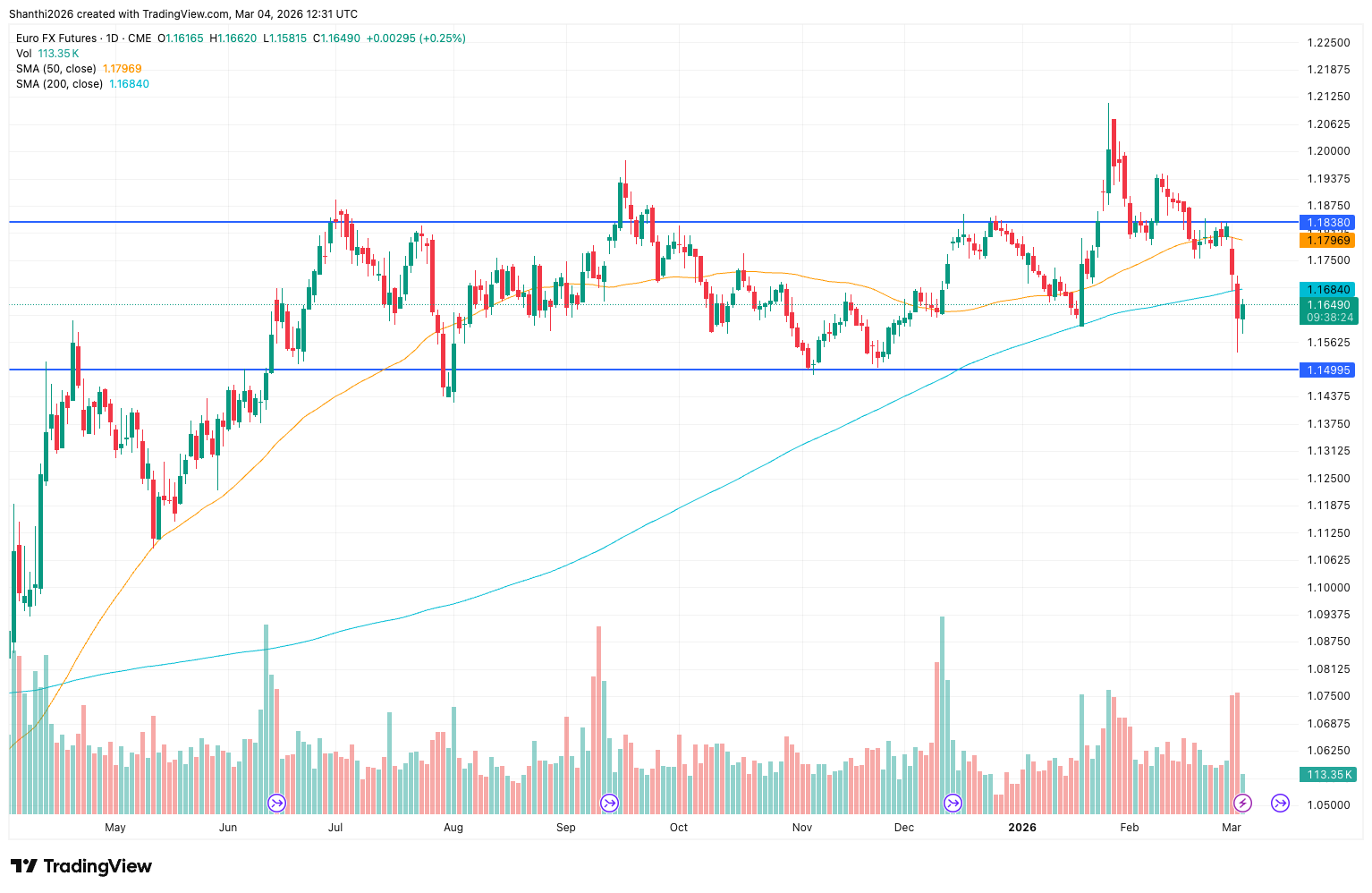
Source: TradingView
With the eurozone inflation remaining below the central bank’s 2% target for the second straight month in February, the ECB could have the leeway to drop interest rates this month, provided the geopolitical tensions in the Middle East abate. This poses downside risk to the 6E contract. On the downside, it has a support zone around the $1.15 level.