
A private payrolls report released Wednesday affirmed that the job market is well on its way to recovery after a brutal year. The private sector in the U.S. added more jobs than anticipated, according to ADP’s private sector employment report.
The Dollar Index futures cut some of its losses following the release of the report but continued to show modest weakness early Wednesday.
Dissecting ADP’s February Print: Private employers added 63,000 jobs in February following the downwardly revised gains of 11,000 for January. The headline number overshot the economists’ estimate of 50,000 but the downward revision that cut January’s job gains by 11,000 should stir uneasiness among traders.
The service-providing sector accounted for the bulk of the job gains (+47,000), with strong gains in the education/health services (58,000) partly offset by the 30,000 job losses in the professional business services sector. On the other hand, the goods-producing sector added 16,000 jobs, thanks mainly to the addition of 19,000 construction jobs. The manufacturing sector continued to bleed, losing 5,000 jobs.
The report also showed that pay for job-stayers rose 4.5% year over year (YoY) in February. The annualized pay growth for job-changes slowed to 6.3%.
Economists Say Lukewarm Print: ADP’s Chief Economist Dr. Nela Richardson said, “We've seen an increase in hiring and pay gains remain solid, especially for job-stayers. But with hiring concentrated in only a few sectors, our data shows no widespread pay benefit from changing jobs.”
The economist noted that the pay premium for switching employers hit a record low in February.
Renaissance Macro Research noted that the education & healthcare services added the most jobs in any month in the past year. Excluding the segment, ADP has been treading water for the last six to seven months, it added.
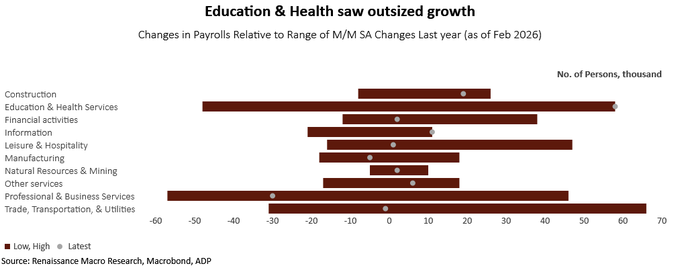
Source: Renaissance Macro Research
What’s Next for Futures Traders: The non-farm payrolls (NFP) report would be the next major catalyst the market would look forward to. The ADP number may not have a perfect correlation with the Bureau of Labor Statistics’ (BLS) data but directionally, both align.
The consensus estimate calls for non-farm payroll expansion of 58,000 for February, slower than the 130,000 pace of job gains in the previous month.
Previewing the NFP report, Comerica Chief Economist Bill Adams said the U.S. likely registered another month of job growth outpacing last year’s meager rate in February, with the unemployment rate holding steady. The economist sees the annual benchmark revisions to the household survey likely grabbing eyeballs.
“Post-revision, the household survey may well show that employment fell over the last 12 months,” Adams said. If the unemployment rate is largely unchanged, the Federal Reserve is still very likely to hold rates steady at their next decision on March 18, he added.