
Macro readings released by the Eurostat, the statistical arm of the European Union (EU), on Friday vouched for the 27-nation economy’s resilience. The euro, the common currency of the 21 nations that are part of the European Union, showed muted reaction to the data.
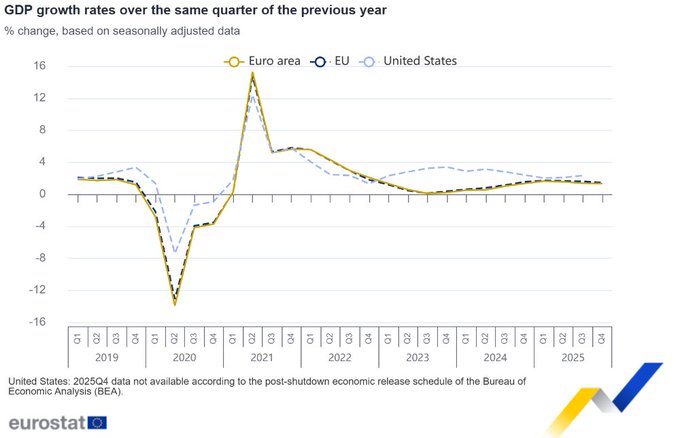
Stable Growth: Eurozone GDP grew at a seasonally adjusted 0.3% quarter-over-quarter (QoQ) in the fourth quarter, the same pace as in the previous quarter and aligning with the consensus estimate, flash estimate revealed.
On a year-over-year basis, eurozone GDP grew 1.3%, slightly slower than the 1.4% pace in the third quarter, but in line with the consensus estimate. For 2025, eurozone’s GDP grew 1.5%.
The EU’s fourth-quarter GDP rose 0.3% Q-o-Q and 1.5% YoY, down slightly from the 0.4% and 1.6% growth, respectively in the third quarter. The annual growth for 2025 was 1.6%.
Source: Eurostat
Among member nations, Lithuania, Cyprus and Poland reported the fastest sequential growth, while Romania posted the weakest growth. Ireland recorded the fastest YoY GDP growth, while Romania reported negative growth.
Eurostat also released employment data, showing a 0.6% YoY increase for the euro area jobs and a 0.7% increase for the European Union. The growth rates for the third quarter were at 0.6% and 0.5%, respectively.
The lack of upside growth surprise limits hawkish repricing, leaving the Euro futures (6E) vulnerable to selling the strength unless inflation data tempers ECB cut expectations.
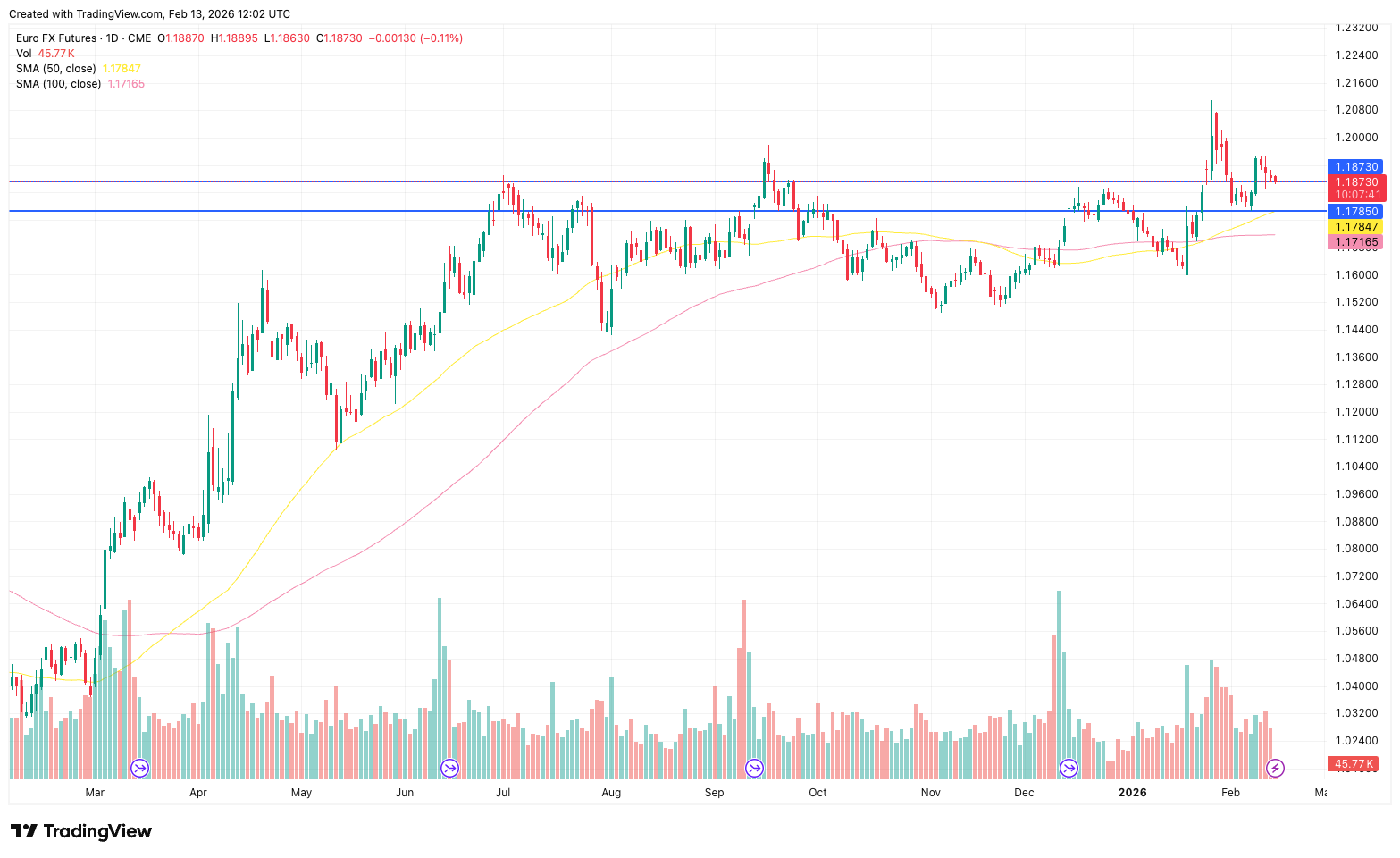
Euro FX futures (6E) remain in an overall bullish trend, but price action has shifted into consolidation after the late-January breakout rally. The contract is holding above its key moving averages, with the 50-day SMA near 1.1785 acting as first support and the 100-day SMA around 1.1715 serving as a deeper trend floor. Immediate resistance is seen near 1.1875–1.1880, with a stronger upside trigger above the 1.2000 psychological level. A breakdown below 1.1715 would weaken the bullish structure and expose downside risk toward the 1.1600 zone.
Source: TradingView
Will Data Move The ECB: Given the GDP growth is steady and slowing YoY growth and only moderate job growth, the European Central Bank could stick to its easing bias. Earlier this month, the Governing Council of the ECB decided to keep all its policy rates unchanged. While stating that the rate-setting council would not pre-commit to a particular rate path but would base its rate decision on its “assessment of the inflation outlook and the risks surrounding it, in light of the incoming economic and financial data, as well as the dynamics of underlying inflation and the strength of monetary policy transmission.”
Futures traders will now likely focus on incoming inflation, wage growth, private sector activity readings that could sway the central bank’s rate decision.