After three years of sluggishness, crude oil has finally found its mojo back, thanks to the U.S.-Iran war that is threatening large-scale supply disruptions. The headlines from the region have lifted prices of energy commodities sharply higher this week, with the West Texas Intermediate (WTI) grade crude oil futures (CL) rising nearly 14% to more than $92-a-barrel mark, the highest level since October 2023.
The futures contract (BZ) tied to the Brent crude, the benchmark for the commodity in Europe, also advanced sharply, touching nearly $94 in the process.
Gulf Output Disruptions: With hostilities between the U.S.–Israel coalition and Iran escalating over the weekend, energy commodities have faced upward pressure on prices. The gains accelerated on Friday after Gulf officials warned that oil could surge further if the conflict persists.
Oil prices could surge to $150 a barrel if the war forces Gulf energy exporters to halt shipments, Qatar’s Energy Minister Saad al-Kaabi warned in an interview with the Financial Times. Qatar, one of the world’s largest liquefied natural gas (LNG) producers, halted production at its Ras Laffan LNG complex following missile strikes and declared force majeure, shielding itself from penalties for failing to meet contractual obligations due to extraordinary events.
A separate FT report said Iraq has shut down most of its oil production and Kuwait is likely to follow suit since the storage facilities in these countries reach their full capacity. Vessel traffic through the Strait of Hormuz, which transports 20% of the world’s crude oil and natural gas, has dropped to just 2 on Thursday, down markedly from the per-day average of 138, Oilprice.com reported, citing data from the Joint Maritime Information Center.
Economists More Sanguine: A 2022-like energy shock, when energy prices jumped in the aftermath of Russia’s invasion of Ukraine, fanning inflationary pressures, may not materialize, according to ING economists. The percentage rise in Brent crude and TTF natural gas prices in the aftermath of the Middle East conflict and the Ukraine war show that price rise was steeper in 2022 than now.
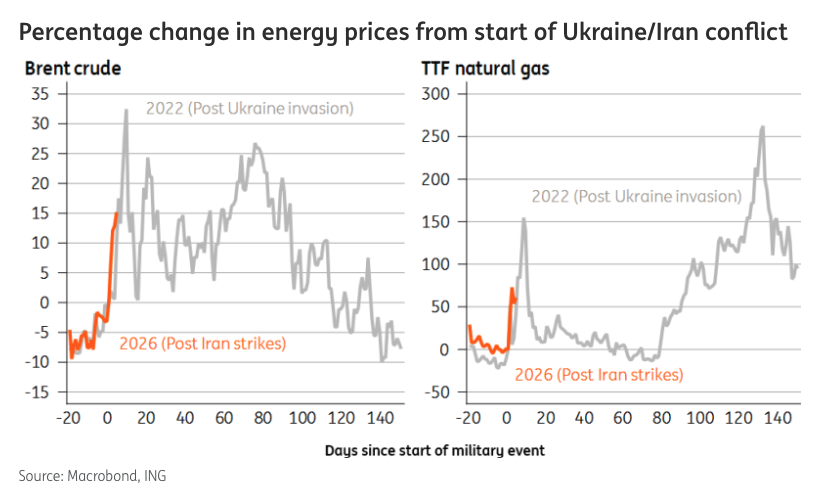
Source: ING
According to ING, the job market is now much cooler than in 2022, likely keeping a lid on inflation. Supply chains are now much healthier than in 2022, the firm stated. But the firm remained wary of tariff-related uncertainty.
“The 2022 energy crisis landed on a global economy that was ripe for inflation to take off: Supply chains were fractured, job markets tight, and fiscal policy was fuelling the fire. All of that, to varying degrees, is less true today,” ING said.
OPEC Handicapped? OPEC, an association of the major oil-producing countries of the world, could do little to alleviate the evolving supply crunch. RBC Capital Markets Head of Global Commodity Strategy Helima Croft said, “The absence of serviceable sea lanes essentially renders any production increase an entirely moot point, as the lion's share of OPEC barrels in the region could become stranded assets in an extended war scenario..”
What Futures Traders Should Watch? The resumption of tanker traffic through the Strait of Hormuz could be key to reining in spiraling oil prices. That would likely require a truce between the U.S. and Iran to de-escalate tensions in the region.
In a Truth Social post on Friday, U.S. President Donald Trump said, “There will be no deal with Iran except UNCONDITIONAL SURRENDER! After that, and the selection of a GREAT & ACCEPTABLE Leader(s), we, and many of our wonderful and very brave allies and partners, will work tirelessly to bring Iran back from the brink of destruction, making it economically bigger, better, and stronger than ever before.”
His comments and Iran's resistance suggest that the conflict could take longer to resolve than what the market is factoring in currently.
Read Next: Shock Payroll Decline Clouds Labor Market Outlook, Tempering Expectations for a Fed Pause