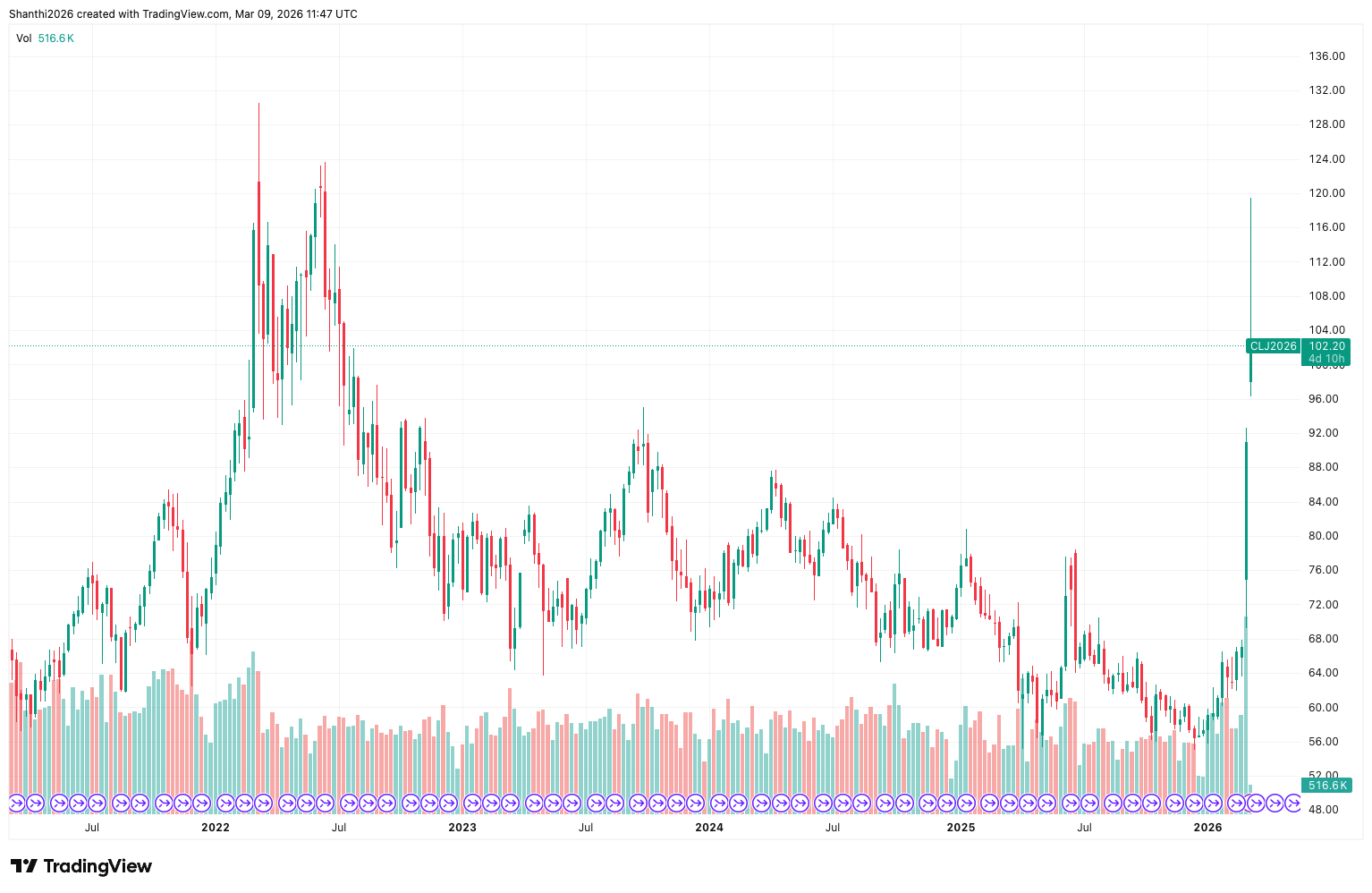
Futures tied to the U.S. and Europe crude oil benchmarks breached the $100 barrier on Monday as the situation in the Middle East worsened further as the U.S.-Iran conflict showed no signs of a let up.
As crude futures head northward, the stock index futures have come under pressure, and so also have commodities, denominated in the U.S. dollar. Fears of pricier oil stoking inflationary pressure has lent support to the Dollar Index futures (DX).
Supply Concerns Drive Up Prices: West Texas Intermediate (WTI) crude futures (CL), the U.S. benchmark, surged to $119.48 in the Asian session before easing, though prices remained above $100 a barrel. The $100 psychological barrier has been breached for the first time since July 2022.
Source: TradingView
Brent crude futures (BZ), the European benchmark, also topped $119 before retreating.
The price spike came on the back of the U.S.-Israel alliance continuing to pound Iran with missiles, causing damage to oil storage and refining facilities. Iran hasn’t backed down either, as it carried out drone attacks targeting fellow Gulf countries.
In another development, Iran’s Assembly of Experts chose Mojtaba Khamenei, the second son of slain leader Ayatalloh Ali Khamenei, as the latter’s successor, with top officials in the country and the Islamic Revolutionary Guard Corps also pledging allegiance to him.
Also, the closure of the Strait of Hormuz has forced oil producers from the Gulf region to shut down production due to storage constraints. Iran has reportedly reduced output by about 1.5 million barrels per day (mb/d) and Kuwait has reportedly trimmed production by 300 thousand barrels per day (kb/d).
ING’s Head of Commodity Strategy Warren Patterson said, “The combination of these production shut-ins and no signs of de-escalation in the war means the market is having to aggressively price in a prolonged supply disruption.” The strategist expects oil prices to continue to climb higher as long as oil’s movement through the Strait of Hormuz is stalled.
That said, the retreat from the highs came after a Financial Times report said the G-7 nations are discussing the possibility of releasing oil from the International Energy Agency (IEA) reserves.
Weighing in on the latest positioning data from the Commodity Futures Trading Commission (CFTC), ING’s Patterson said speculators surprisingly decreased their net long in ICE Brent over the last reporting week. The managed money net long fell by 35,358 lots to 285,594 lots, driven primarily by long liquidations. The open interest in ICE Brent also hit its lowest level since December, he added.
The Week That Was: After reports of the U.S.-Iran war emerged over the weekend in late February, oil, which had turned in a lackluster performance for three straight years, got its mojo back. The CL contract jumped 35.6% for the week ended March 6, the biggest weekly advance on record (since March 1983 when the contract debuted on the NYMEX).
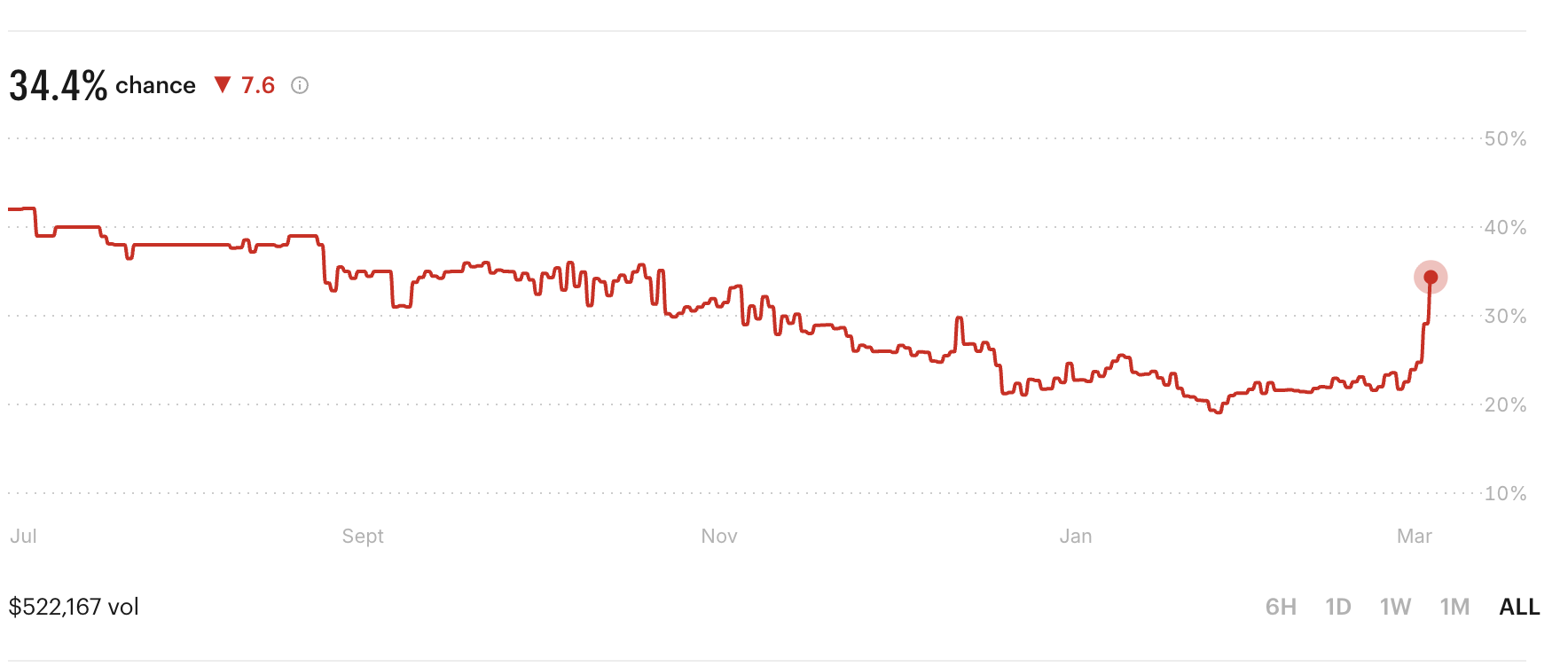
Equity Futures Under Pressure: Fears of the Middle East conflict prolonging more than the market has factored in, have sent stock index futures for three straight sessions. Market participants are jittery about the run up in oil prices potentially causing a global economic slowdown and an inflation crisis. The odds of a recession in the U.S. has spiked in the aftermath of the developments in the Gulf, jumping to 35% from under 20% in early February, according to prediction market Kalshi.
Source: Kalshi
The E-mini S&P 500 (ES), the Nasdaq 100 E-mini (NQ) and Dow E-mini (YM) futures slid over 1% each early Monday.
The major Asian benchmarks fell sharply on Monday, with the yen-denominated E-mini futures tied to Japan’s Nikkei 225 Average being the worst hit.
What’s Next for Markets: Danish investment bank Saxo expects volatility to remain elevated at the start of the week as investors digested the escalation in the Middle East conflict. The CBOE Volatility Index traded at its highest level since April 2025, when U.S. President Donald Trump’s “Liberation Day” tariff announcement produced wild swings in the market.
While the simmering Middle East tensions could engender volatility, traders may also keep an eye on the U.S. consumer price inflation (CPI) data due on Wednesday. The all-important rate-setting meeting of the Federal Reserve has been scheduled for March 17-18. A pause decision has been factored in by futures traders, as evident from the CME FedWatch Tool, which puts the odds of a status quo stance at 97.4%.