
The Japanese yen futures (6J) weakened in early New York session on Wednesday as the U.S. dollar continued to firm up. Futures traders also reacted to the mixed results of the Reuters Tankan survey.
The survey results were based on a poll of 492 non-financial companies conducted Feb. 3-13, and the sentiment was calculated as the difference between those optimistic and pessimistic.
Mixed Messaging: The monthly survey found that the manufacturers’ sentiment index rose to +13 in February from +7 in January, with the latest monthly reading marking the highest since November.
The improvement reflected a strong rise in sentiment among machinery manufacturers. The corresponding index climbed to +15 from 0. On the other hand, sentiment among transport machinery manufacturers, including automakers and component suppliers fell to +33 from +40. Anecdotal evidence flagged falling domestic vehicle sales and Chinese rare-earth regulations as the major concerns.
On the other hand, the non-manufacturers’ sentiment index slipped to +25 from +32, underlining waning confidence across sectors. A service sector manager reportedly stated that the “decline in inbound demand, particularly from China, has become more noticeable recently, helping intensify competition with other companies and putting downward pressure on prices.”
Future Tense: Reuters reported that manufacturers see sentiment slipping to +10 in May, while non-manufacturers expect conditions to slip further to +23.
Meanwhile, Goldman Sachs expects the Japanese economy to continue to grow in 2026, thanks to domestic demand. The firm expects 0.8% growth for the year even, with an anticipated deceleration likely offset by solid consumption and capex. Goldman also sees worsening of the debt-to-GDP ratio due to the expansionary fiscal policy and potential interest rate hikes. “Securing market confidence in fiscal policy and appropriate debt management policies will become even more important,” the firm said.
The outlook for 6J is tempered by potential dollar strength as incoming data from the U.S. has been fairly strong.
Rangebound Trading: The JPY futures have been range-bound since the middle of 2023, trading in the 0.00626 and 0.00726 range. February has shown considerable volatility as 6J swung wildly amid the ruling Liberal Democratic Party (LDP) securing a landslide victory in the general election. The party’s leader Sanae Takaichi, a fiscal dove, was re-elected as the Prime Minister at the Diet following its electoral win.
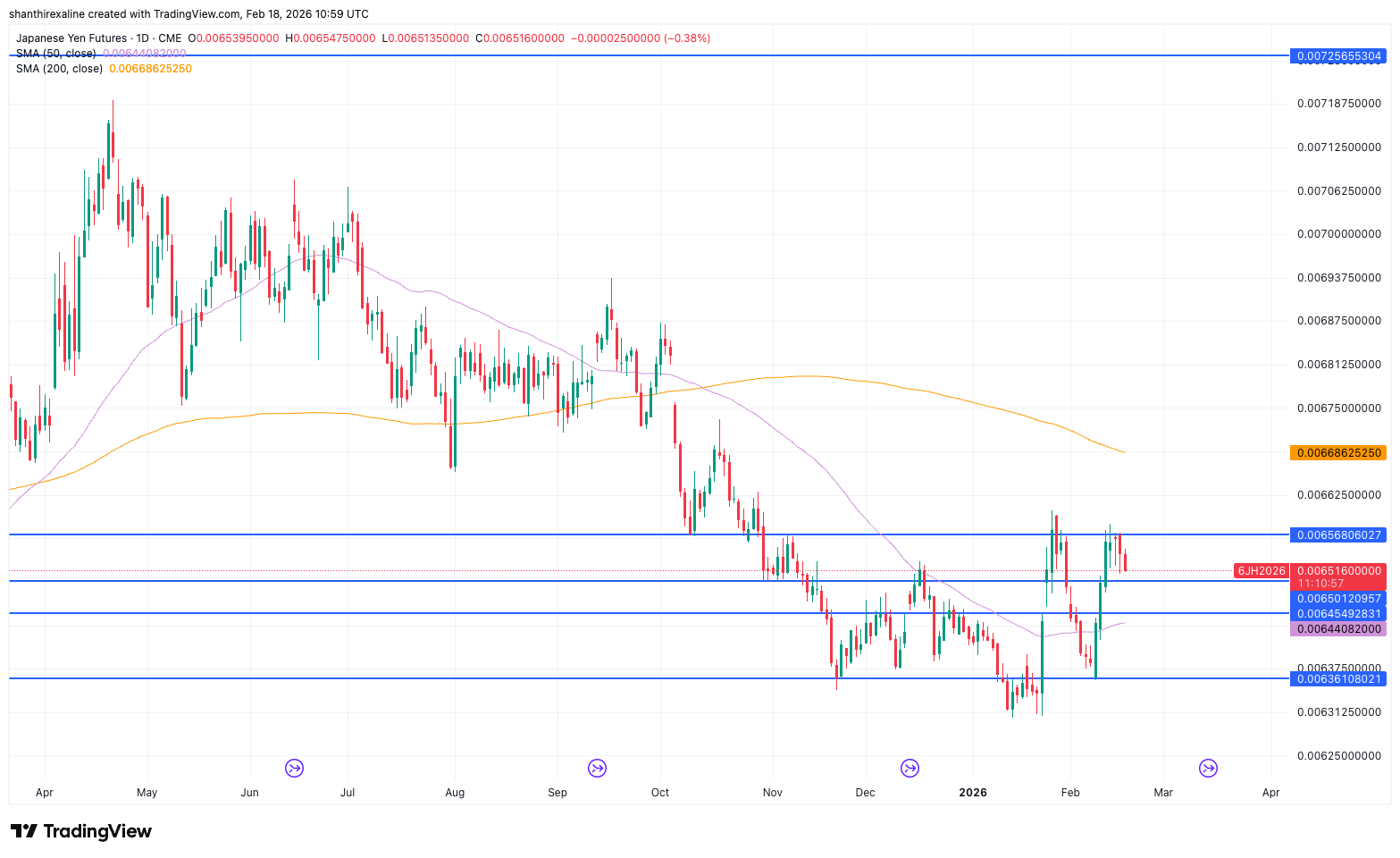
Source: TradingView
The Japanese Yen futures remain trapped in a consolidation zone after rebounding sharply from mid-January lows, with upside momentum capped by a key resistance band near 0.00657. The contract is trading below the 200-day simple moving average (SMA) at 0.006686, keeping the broader trend biased to the downside despite the recent recovery.
Immediate support lies at 0.00650, followed by 0.00645, where buyers have repeatedly defended declines. A break below 0.00645 could expose deeper downside toward 0.00636, the next major floor on the chart. On the upside, a sustained move above 0.00657 would shift near-term sentiment bullish and open the door toward the 200-day SMA at 0.006686, with further gains potentially targeting 0.00675 and 0.00690.
Read Next: Long USD Bias Strengthens as New York Fed Survey Signals Expansion and Reignites Inflation Pressures