A couple of data released by the Bureau of Economic Analysis (BEA) on Friday sent conflicting messages to the Federal Reserve, which has vowed to stick to its data-dependent stance. While the economy grew at a weaker-than-expected pace in the fourth quarter, a key inflation measure reinforced the stickiness of the pricing pressure.
The U.S. dollar Index futures, which held its ground following the mixed data points, came under pressure after the Supreme Court ruled President Donald Trump’s tariffs as illegal. Meanwhile, bond prices fell, sending yields higher amid rising odds for an extended pause.
Inflation a Wall of Worry: A BEA report showed that the annual rate of the price consumption expenditure (PCE) index and the core PCE index accelerated to 2.9% and 3% in December from 2.8% each in November. Economists, on average, expected 2.8% and 2.9% rates, respectively.
The PCE index is the Fed’s preferred inflation gauge, and plays a central role in monetary policy decisions.
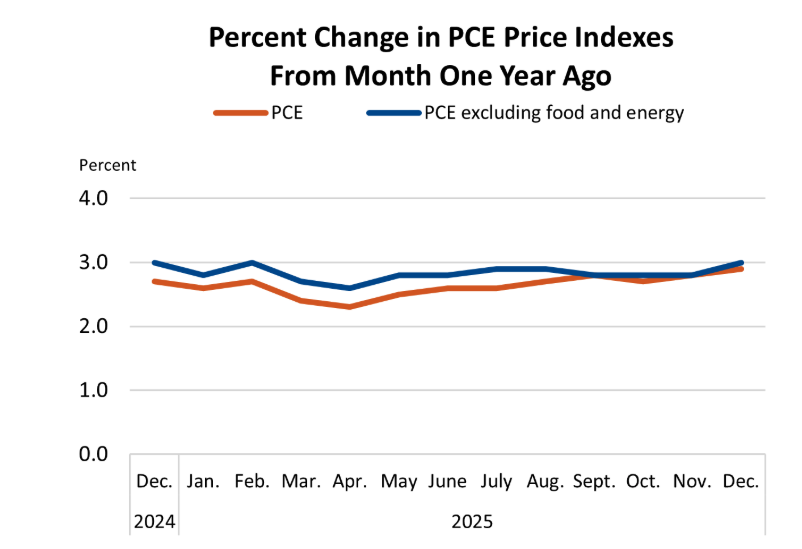
Source: BEA
On a month-over-month (MoM) basis, the PCE index and the core PCE index were up 0.4% each, slower than the 0.2% increases in November.
Personal spending 0.4% MoM in December, the same pace as in the previous month, and aligning with the consensus estimate. The monthly rise in personal income was 0.3%, slower than the 0.4% increase in November. The personal savings rate as a percentage of disposable personal income (personal income less personal current taxes) was 3.6%.
Growth Disappoints: Advance estimates released by the BEA showed the U.S. economic growth decelerated to 1.4% in the fourth quarter from 4.4% in the preceding quarter. The growth rate also trailed the 2.8% pace estimated by economists.
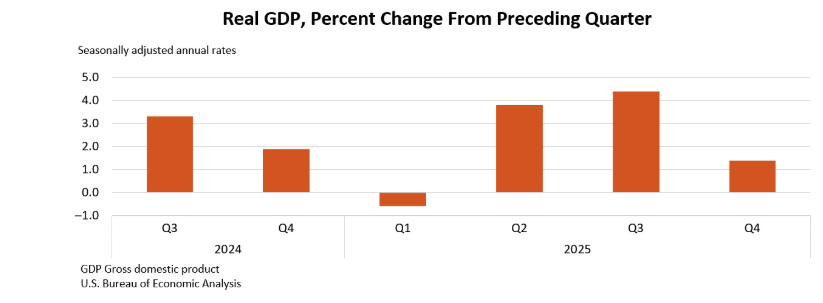
Source: BEA
The fourth-quarter slowdown was a function of a declaration in consumer spending growth, and declines in government spending and exports. Northlight Asset Management Chief Investment Officer Chris Zaccarelli attributed the slowdown partly to the record government shutdown. If not for the shutdown, the growth would have been close to 2.4%, the strategist said, citing some estimates.
Accelerated investment, however, helped to offset some of the drags.
The PCE index climbed 2.9% in the fourth quarter, faster than the 2.8% pace in the previous quarter. The growth in the core PCE index, however, slowed to 2.7% from 2.9%.
The economy expanded at a 2.2% pace for 2025 compared to 2.8% in 2024.
Bolvin Wealth Management President Gina Bolvin said, with the PCE inflation running near 3% over 2025, the Fed’s job isn’t finished. “That combination—slower growth with still-sticky inflation—keeps policymakers cautious and markets measured,” she said.
With inflation still sticky and growth slowing, the Fed may delay rate cuts, supporting yields and the dollar. Traders could look to buy U.S. dollar index futures on dips or maintain a cautious, short bias in Treasury futures if yields continue to edge higher. A sharper slowdown in growth would be the main risk to this view.