
A trio of reports released on Thursday painted a largely upbeat picture of the U.S. economy, although they still left room for rate cuts later this year.
The U.S. Dollar Index futures (DX), which breached the 98 psychological resistance for the first time in nearly a month ahead of the data, has eased off the mark since then.
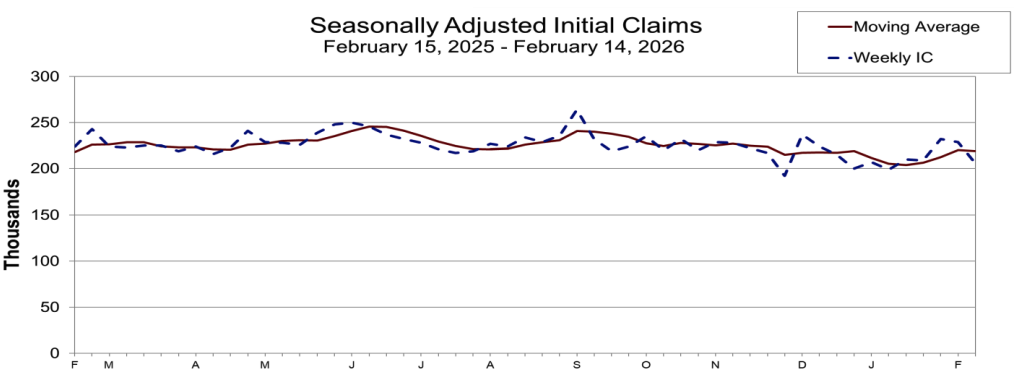
Jobs Data Sends Mixed Signal: The number of individuals claiming unemployment benefits declined 23,000 to 206,000 in the week ended Feb. 14, according to a report released by the Labor Department. Economists, on average, expected jobless claims to have increased to 223,000 from the initially reported 227,000 for the previous week.
Source: DOL
The four-week average fell 1,000 to 219,000.
Meanwhile, continuing claims, which is calculated with a week’s lag, climbed 17,000 to 1.869 million in the week ended Feb. 7 versus the consensus estimate of 1.860 million. This measure represents the number of individuals already receiving unemployment benefits but continue to file for them.
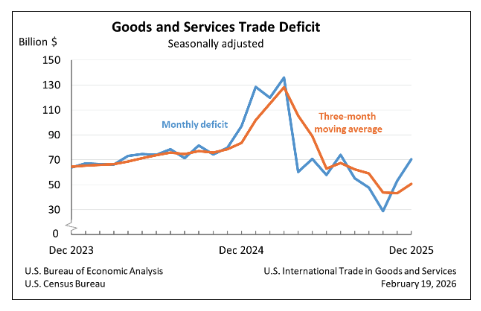
Trade Gap Widens: A separate Census Bureau report showed that the trade deficit for December widened to $70.3 billion from $53 billion in November. The consensus estimate had called for a surplus of $55.50 billion for the month.
Source: Census Bureau
The widening reflected a 1.7% month-over-month (MoM) drop in exports and a 3.6% increase in imports.
The trade deficit for 2025 edged down 0.2%, with 6.2% export growth outpacing the 4.8% import growth.
Regional Manufacturing Soars But… The Philadelphia Federal Reserve’s diffusion index for current business activity climbed to 16.3 in February from 12.6 in January, indicating a faster pace of expansion. The headline index was also the highest since September last. A reading above ‘0’ suggests the sector is in expansion territory. Economists, on average, expected a deceleration, modeling a reading of 7.5.
The inner details, however, were mixed. The shipments index fell 9 points to 0.3, and the new orders index fell to 11.7 from 14.4 but remained just above its long-run average.
The employment index dipped into negative territory (-1.3) for the first time since June, and the average workweek index also fell, dropping to -11.6 from 9.1. The price indices, although moving lower, remained elevated.
The index for future general activity jumped 25.5 points to 42.8 in February, stalling a two-month drop.
Implications for Fed funds rate: The data mix is likely to keep the Fed in a wait-and-see stance rather than push it toward immediate easing. Summing up the read-across, Northlight Asset Management Chief Investment Officer Chris Zaccarelli said the economy isn’t falling off a cliff, and “yet there isn't so much strength that the Fed will feel compelled to stop lowering interest rates.”
What Do Futures Traders Take Away? The data is good but not too hot, signaling that rate cuts may come later this year. The Dollar Index futures (DX) could be sold on strength. Alternatively, buying the 10-year Treasury futures (ZN) on dips could also prove to be a profitable trade at least for now.
The focus now shifts to Friday’s personal income and spending report for December, which consists of the core price consumption expenditure index, which is the Fed’s favorite inflation gauge.